
Content Note: This article mentions the impacts of residential school and intergenerational trauma.
Key Takeaways for Communities
- Housing programs that are low-barrier, trauma-informed, and flexible will lead to people finding a safe, permanent place to call home. Wraparound supports for individuals help them exit homelessness and remain successfully housed.
- Centring lived and living experience in service delivery and leadership roles builds trust and creates visible pathways from survival to sustainability.
- Pairing housing programs with permanent housing solutions is crucial for individuals to find long-term successful housing placements.
The house was mostly quiet, just a few mornings before Christmas, as Bonnie Aggamway assembled harm reduction kits in the dining room.
The occasional resident said good morning, as they stepped down the wooden stairs and into the kitchen to fill their mugs with coffee.
“This place is a lot of different things for people, depending on where they’re at in their own journeys. But mainly, this home is a soft landing,” said Aggamway.
“It’s a supportive space where people are there to help you. We know the struggles you’ve been through, whether it’s coming off the streets or from jail to here, it’s a really good starting point to recover … and we’re here to support them through that whole process from being unhoused to eventually permanently housed.”
Aggamway is the substance use health coordinator with the Elizabeth Fry Society of Northwestern Ontario (EFSNWO), working at the transitional housing program to provide housing and supports for up to two years for women and gender-diverse people experiencing homelessness in Thunder Bay.
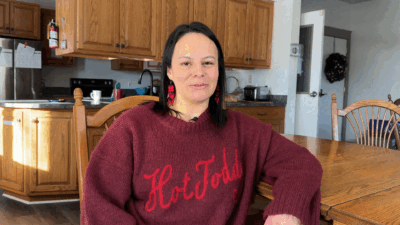
Bonnie Aggamway is the substance use health coordinator with the Elizabeth Fry Society of Northwestern Ontario.
The low-barrier, harm reduction-based housing program has 36 beds spread across three houses — each with a different level of supports tailored to the needs of residents. EFSNWO also provides food bags and clothing assistance to residents and community members in need.
“We’re filling a lot of gaps. Without housing, nothing else can really exist. If someone doesn’t have a place to sleep, and they have to deal with the daily struggles of being unhoused, it’s really hard to do anything. It’s hard to be consistent. It’s hard to follow through. It’s hard to just survive,” said Aggamway.
In 2025, the team helped 34 people to find permanent housing, providing support along that entire journey and following up with residents after they moved into their own place.
A place of ‘radical love and acceptance’
Melissa Quinn is one of the women who found permanent housing last year, thanks to the support from Elizabeth Fry staff.
“It meant the world to me. I was looking at going back into the shelter system, with over a year in recovery, and I wouldn’t have made it,” Quinn said.
“I wouldn’t be the person who I am today, if Elizabeth Fry didn’t come in and fill that gap for me.”
Quinn says she grew up in a household where substance use was very normalized and first started using crack cocaine — the same drug both her parents used — right as the first COVID-19 restrictions shuttered society.
“I became obsessed with using. That happened so quickly. I lost my apartment within about six months … it was just a whirlwind … I was like just going from trap house to trap house. Getting kicked out of one trap house, going to a different one … it was just absolute chaos,” said Quinn.
In total, it was about two years of experiencing homelessness, moving from couch to couch, in and out of emergency shelters, and ultimately the Thunder Bay District Jail. During a six-week jail sentence, Quinn decided to stop using substances.

Melissa Quinn found permanent housing last year, thanks to the support from Elizabeth Fry staff.
She got into a substance use treatment facility and then spent one year in a post-treatment program. Facing homelessness yet again after that program ended, Quinn was offered a spot in EFSNWO’s transitional supportive housing program in December 2024.
“I was offered a lot of support in a transitional period of my life. A time where things were very much up in the air for me … having somebody that I could lean on when I was struggling … I had never experienced that in my life, that radical love and acceptance,” she said.
After living at the transitional supportive housing program for five months, Quinn was offered a private market rental unit from a friend.
“I was very scared to be on my own … it’s such a huge adjustment going from the shelter system and being unhoused and living on people’s couches to having my own bed and my own space. It’s almost overwhelming,” said Quinn.
Elizabeth Fry offers a “slow transition,” which meant Quinn was able to slowly move into her own apartment over the course of a month, spending some nights at the transitional supportive housing and some nights at her own place.
“People were always checking in on me, always making sure I was okay. I remember coming and dropping my keys off here [at the supportive housing program]. That was a monumental moment for me. I was like, ‘here we go, on to the next chapter.’”
Permanent, affordable housing for all Canadians is the only way to truly reduce and end homelessness, said Victoria Boyle, the Canadian Alliance to End Homelessness’s (CAEH) lead Improvement Advisor for Thunder Bay.
“Melissa’s story demonstrates the power of providing the supports and longer-term follow-up that many people need to find and maintain that housing, especially after a long period experiencing homelessness,” Boyle said.
The next chapter — giving back
Today, Quinn works at the transitional supportive housing program as an outreach system navigator. Like many others working at the housing program, Quinn brings her lived experience to help others.
“That is my purpose today in life, to give back what was so freely given to me … most of our clients know that I used to be a client, and I’d like to think that it gives them a degree of hope. Because there is a way out of being unhoused … sometimes all it takes is someone saying, ‘hey, I got out of this, and you can too,’” said Quinn.
As substance use health coordinator, Aggamway similarly pulls from her own lived experience to help residents at the transitional supportive housing unit achieve their substance use goals.
“I see successes almost every day in the work I do, whether it’s people that are choosing safer ways to use drugs, or someone who has access to the medical care that they need after they were on the street for a long time, or someone who is seeing their kids again,” she said.
Aggamway has experienced every one of those moments. Her mother went to residential school and Aggamway was raised in a different family, experiencing childhood trauma, using substances as early as 12 years old, getting kicked out of the house, and having her first child at the age of 19.
“I was already caught up in the system with the law, addiction, just everything. From about 12 to 18 years old, I was struggling. It was really tough, and I didn’t have a lot of support,” said Bonnie Aggamway.
“I kind of lived my life backwards to this point. From having kids at a young age and trying to be a mom with no skills, it was really hard. I went to university for a while and I took social work. I tried everything I could to be a good parent without the skills of being parented in a good way, that you learn in a stable family … my kids ultimately were caught up in the system next. It’s really a lot of intergenerational trauma.”
Aggamway said she spent a huge part of her life struggling, going from substance to substance, toxic relationship after toxic relationship, in and out of the hospital, detox, shelters and jail.
Then she was connected to the Ontario Native Women’s Association, who helped her make sense of the intergenerational trauma her family had experienced, and supported her to navigate the medical, shelter and housing systems.
“They helped me understand those things and really helped start to rebuild me in ways that I didn’t even know were possible,” she said.
Years later, Aggamway started volunteering with Elizabeth Fry and then started working for the organisation.
“I started to believe that all the struggles that I had, it needed to have purpose, and I needed to help other people … I loved it right from the start. Now, three years later, I’m sitting here and I’ve changed from a system navigator to a coordinator, which is pretty amazing. That wouldn’t have happened if I wasn’t given the chance,” she said.
It’s so important for communities to have people with lived and living experience at the centre of the response to homelessness, says Boyle:
“The heart, skills, and expertise of people with lived experience is invaluable. Having that first-hand understanding of the path that others are walking provides a level of insight and comfort for those trying to find and maintain their permanent home.”
Rapid growth of program in recent years
Elizabeth Fry’s transitional supportive housing program in Thunder Bay started just before COVID-19, initially with a single apartment unit funded with $75,000 of Reaching Home funds, administered by the designated community entity Lakehead Social Planning Council (LSPC).
Since then, the program has been built from the ground up and flourished, says Bonnie Krysowaty, director of projects and community initiatives with LSPC.
“It has housed the most people out of all the Reaching Home-funded programmes [in Thunder Bay]. And the bottom line of funding is move-ins, helping more people exit homelessness and preventing it from happening in the first place,” said Krysowaty.
Given the high cost of rent and lack of available and affordable non-market and private market rentals, EFSNWO’s housing navigator Kayla Baxendale says they are able to find permanent housing for two to three residents of the transitional supportive housing program every month.
But still, the resources that Elizabeth Fry can provide are not nearly enough.
“The need is very, very high at this point. During our intakes at the correctional facility, every single individual we talk to is looking for housing upon their release … we don’t have enough beds for the number of individuals that are coming to us,” Baxendale said.
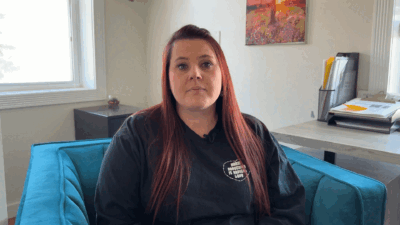
Kayla Baxendale is the housing navigator for Elizabeth Fry Society’s transitional housing program in Thunder Bay.
“Thunder Bay’s rent-geared-to-income housing waitlist is roughly two years … private market is even more difficult. Prices are way too high for anybody with low income, who is on Ontario Disability Support Program or Ontario Works. They almost always need a subsidy to help pay for rent,” Baxendale said.
In the kitchen of Elizabeth Fry’s transitional supportive housing program, Baxendale sits with a resident who is looking for her own home.
Baxendale helps her fill out an application for the Canada-Ontario Housing Benefit — a monthly rental benefit jointly funded by the provincial and federal government to assist people with lower incomes, in more vulnerable conditions, afford to pay rent in the private market.
But Baxendale warns there is a very limited number of housing benefits available for people experiencing homelessness, and there is no guarantee the resident will receive one.
The staff at EFSNWO are doing everything they can to help people heal and recover from the trauma of their experiences of homelessness and provide the supports people need to find and maintain their own permanent homes, Baxendale says.
But this work has its limits.
“An increase in social assistance rates would be a start, but we need more builds. We need more units. We need more housing,” said Baxendale.
This Bright Spot is funded by the Government of Canada.