
CONTENT NOTE: This article contains mention of suicide. If you or someone you know needs help, you can call or text Canada’s 988 Suicide Crisis Helpline.
Key Takeaways for Communities
- Community entities and homelessness system planners play an essential role in identifying the current and projected number of supportive and affordable housing units that will be needed to end homelessness.
- To reduce and ultimately end homelessness, communities must fill their vacant affordable and supportive housing units through their By-Name Data.
Rej never thought he’d find himself in this position.
He worked his entire life. Always had a place to stay, whether it was a room, an apartment, or his own house.
“Always paid my rent. Paid my mortgage. And all of a sudden — bang — something happens that you least expect, and you sit there, and you say, ‘okay, what am I going to do now?’” Rej said.
At 73 years old, Rej was diagnosed with a health condition that meant he could no longer work the security job he’d held for more than 10 years.
“Because of my physical condition, I couldn’t do the job anymore, so I had to leave. The income was not there anymore. I couldn’t afford to live where I was,” he said.
“You got friends and family that are willing to help you, but they also have their lives, and basically, you don’t want to be a burden to anyone else.”
Without a home for the first time in his life, Rej went to the emergency shelter in Oakville. He stayed there for several months, before receiving an offer to live at 265 Kerr Street, one of the newest affordable and supportive housing developments in Halton Region.
“I remember when I moved here in August 2025, bringing all my stuff in … I was in my apartment, looking around, and got very emotional. Finally, I got my own place. Finally, I can pay the rent. Finally, I can afford it. Finally, now I can move forward,” Rej said.
Halton aiming to build 165 new supportive housing units
The 52-unit building at 265 Kerr Street was purpose-built and finished in June 2025.
There are 30 units dedicated to seniors on the subsidized housing waitlist — a list that has grown by 72 per cent since 2021, with more than 8,000 households in Halton waiting for an affordable place to live.
There are another 22 studio apartments of supportive housing for seniors experiencing homelessness with chronic health and mobility needs.
The housing is long-term transitional with supports, meaning residents can stay up to four years at the unit to recover from their experiences of homelessness, while receiving tailored support from staff to find a permanent home. And if they need more time, residents can extend their stay at 265 Kerr Street.
“Over the last few years, we’ve seen an increase in older adults experiencing homelessness, and we wanted to fill that gap. That’s why we moved ahead in prioritizing new supportive housing for older adults,” said Tiffany Dorman, manager of homelessness and supportive housing with the Regional Municipality of Halton.
The supportive housing units were filled entirely by older adults identified in Halton’s By-Name Data — a timely database of all people experiencing homelessness in the region, including details about the supports they need to find and maintain a safe and affordable place to call home.
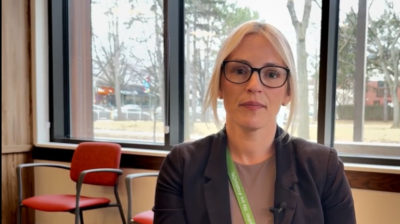
Tiffany Dorman is the manager of homelessness and supportive housing with the Regional Municipality of Halton.
“Communities end homelessness when they have quality data that helps them understand how people are falling into homelessness, and when they use that same data to make decisions and drive investments into their community,” said Dawn Wheadon, the Canadian Alliance to End Homelessness’ lead improvement advisor for Halton.
Most people experiencing homelessness in Halton don’t need permanent supportive housing. Dorman says many are going through a hard time and need a temporary home with intensive, personalized supports to help them move along the housing continuum and into more independent housing.
“Our By-Name Data indicates a need for at least 165 new supportive housing units, primarily for individuals with high-acuity needs who require more intensive supports to successfully maintain housing in the community,” she said.
That’s how the Regional Municipality of Halton ended up including the target of constructing at least 165 supportive housing units as part of their 2025-35 Comprehensive Housing Strategy.
But Halton isn’t stopping there.
The regional municipality has a portfolio with 535 units of shovel-ready and in-progress projects that will increase the availability of affordable and supportive housing.
With adequate support from the provincial and federal governments, Halton estimates they can create around 1,350 housing opportunities over the next 10 years.
“We are consistently looking for new and innovative projects to enhance our assisted and supportive housing portfolio. 265 Kerr Street is a new build, but we’re also looking at relationships with third-party developers, and at acquiring existing properties,” Dorman said.
Jennifer’s story
Jennifer* was one of the first people to move into an apartment on the second floor when 265 Kerr Street opened.
Many of the staff and residents on the second floor agree, her room should be featured in an interior design magazine.
“Whereas the others were kind of ‘in transit,’ this is a home and you can decorate. It’s just unbelievable. You can put holes in the wall. You can hang pictures. I was shocked when they said that. So, I’ve tried to make it feel like a home for me,” Jennifer said.
Like Rej, Jennifer says she never expected to be homeless.
A single mom, Jennifer worked her entire life, put her daughter through private school, travelled on holidays, and owned her own home.
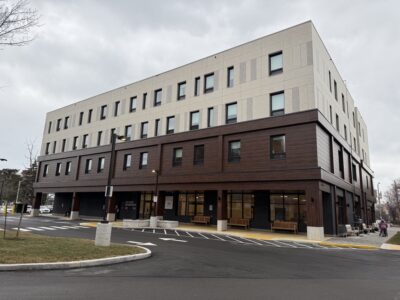
The 52-unit building at 265 Kerr Street was purpose-built and finished in June 2025.
“I had sold my very large house just as COVID-19 hit, and those next few years were difficult and I wasn’t working. I ran out of funds, and that led to the eviction notice,” said Jennifer.
“It feels like a failure, like you have failed at something basic — shelter. I guess people don’t want to think about it, because it can happen to them as well,” Jennifer said.
On the day she was set to be evicted, Jennifer says she attempted suicide. She was found and brought to hospital, where she received treatment for close to three weeks in the psychiatric department.
“I just didn’t think there were any options for me,” she said.
After a brief stint in a psychiatric step-down unit, Jennifer was discharged to a family and women’s shelter in Burlington, where she stayed until being offered an apartment at 265 Kerr Street.
“It’s just such an amazing environment, beyond anything I could imagine. The atmosphere is very community-oriented, and the staff are here looking at every way to help us,” said Jennifer.
‘Longer-term program’ to connect people with supports and a permanent home
Jennifer says staff with Links2Care at the supportive housing facility have helped her feel at home, get connected to a psychiatrist and re-connect with her community. When she’s ready, they’ll help her look for a permanent home.
“I’m trying very hard not to think of it as a personal failure. That’s tough … but I think it’s important that people know services exist, there is a solution. Help is out there,” Jennifer said.
The transitional supportive housing program is longer term, so people have the time to grow, to reconnect, and to recover, says Tiziana Pelusi, manager of Navigate Halton Case Management Transitional Housing Program with Links2Care, the non-profit group operating the program at 265 Kerr Street.
“That time is absolutely necessary. We’re working with older adults, and that amount of time supports them at a pace that they’re comfortable with to find their permanent home. People are not being rushed,” Pelusi said.
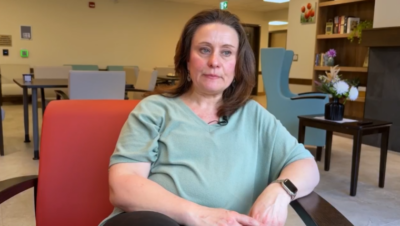
Tiziana Pelusi is the manager of Navigate Halton Case Management Transitional Housing Program with Links2Care, the non-profit group operating the seniors housing program at 265 Kerr Street.
In this way, Halton is building the full housing continuum, factoring in the supports that people experiencing homelessness may need to eventually move into their forever home. Throughout their time at 265 Kerr Street, staff also help residents get the healthcare services they need, create social connections, improve financial literacy and any other skills that residents want support with.
Rej says staff are helping him look for a new job — preferably something he can do from home, like translating documents between English and French.
“I need to work. I need to get up in the morning, and have a place to go, a goal … the thing is my age … even though people are not going to mention it, when they look at my resume and they see the age, it affects the whole process,” he said.
Rej feels confident he’ll get something soon with all the support he has around him. Then, he’ll look at next steps.
“Do I want to stay and live here the rest of my life? No. I’d like to be independent again … when you have your own place, you make your own rules. We’ll see what is in store for me for the rest of my life,” said Rej.
*This Bright Spot is funded by the Government of Canada.