
*Content Note: This story includes mention of intimate partner and sexual violence. If you or someone you know needs help, you can find resources at this link.
Key Takeaways for Communities
- Outreach forms part of the homelessness response system, and is not a standalone service. Housing-focused outreach only works when it is closely connected to other parts of the system, including timely By-Name Data, coordinated access, and actual housing resources.
- Meet people where they are, but don’t leave them there. Effective outreach balances meeting immediate needs like safety, health and basic needs, but are not substitutes for helping people move closer to permanent housing.
- Regular, systematic coordination across multiple outreach teams operating within the same region will reduce overlapping services, and will improve collaboration to reduce homelessness.
Three bright yellow sweaters weave through a block of woods in Lambton County.
They arrive at a small clearing, with two large tents and a few belongings hanging in the trees.
“Good morning! Outreach. Anybody home? We’ve got some snacks and drinks this morning,” shouts Dane Hansen, a community outreach worker with the homeless prevention and social planning department at the County of Lambton.
This encampment, just a small one tucked away from the community, has been in the same location for quite a while, although residents have changed over time. Recently, it’s been the same two people living in this spot, Hansen says.
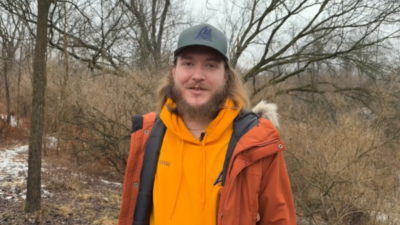
Dane Hansen is a community outreach worker with the homeless prevention and social planning department at the County of Lambton.
“The people staying here now are part of the way through the process of doing a housing application to get them into Rent-Geared-to-Income housing … so they’ll always be able to pay the rent regardless of their financial situation. We’re just looking for those final pieces of the puzzle,” he said.
The three-person community outreach team has ended homelessness for 117 people, helping them move directly into safe and affordable housing.
That’s a significant contribution to the county’s homelessness response system, which typically supports more than 300 people at any given time. It’s a number that has remained relatively constant as new people continue to fall into homelessness, even as others move into housing.
“As we’ve seen more people pushed into homelessness and moving into encampments, the number of outreach teams has increased in communities across Canada. But with so much emergency need, it’s easy to become disconnected from the ultimate goal — moving people into housing,” said Dawn Wheadon, the community’s lead improvement advisor with the Canadian Alliance to End Homelessness (CAEH).
“Lambton County’s outreach team is showing us what’s possible when outreach teams go beyond basic care and relationship building, and make their first point of contact about housing,” Wheadon said.
What housing-focused outreach looks like
Lambton County’s community outreach team was created in the fall of 2022 in response to the growth in the number of people experiencing unsheltered homelessness, said Sarah Churchill, the County of Lambton’s homelessness prevention program supervisor.
“For people who are presenting with more complex needs or unique needs that can’t really be met in an office setting, as well as those with a distrust of institutions … the team was made to be responsive to those needs,” Churchill said.
In the field and at the office, the team’s work is guided by meeting people where they are and removing barriers to housing.
“If you’re living outside, you probably have other priorities instead of getting all your documents in order. You’re just trying to survive day-to-day, and the system can be challenging at the best of times to deal with,” said Hansen.
“It helps to have people like us in your corner.”
That can mean securing IDs, filing taxes, opening a bank account, applying for income supports, and completing rent-geared-to-income affordable housing applications.
‘Homelessness is carrying everything with you’
The peak of visible homelessness in Sarnia came during the summer of 2024, with an encampment of more than 50 tents set up in the downtown waterfront Rainbow Park.
For months, the community outreach team visited the Rainbow Park encampment every day, connecting with people sleeping in the park and supporting them to find safe housing.
That’s where they met Sarah Nickerson, living in a tent with her dog.
Nickerson was raised in group homes through the provincial child welfare system. When she turned 18, Nickerson contacted her mother to be closer to her.
“My mom and I butted heads because of certain things. We are a lot alike. She’s passed now. Rest in peace, mom,” said Nickerson.
For the last 10 years, Nickerson experienced precarious housing, cycling between homelessness and living at her mom’s or a partner’s house.
“Homelessness is carrying everything with you, so you don’t get it stolen. Struggling to sleep. Struggling to stay warm. Pitching up somewhere, and then after so long, getting kicked out of there and having to find a new spot.”
“I had tried applying for places while homeless … but on Ontario Works, you only get $390 for rent [as a one-person household], and most places are $800 plus, so what can you really do?”
During their visits to Rainbow Park, the community outreach team built a relationship with Nickerson, offering snacks, juice, and help to gather documents and apply for income support applications.

Sarah Nickerson is one of 117 people that Lambton County’s community outreach team has helped move from homelessness into housing since 2022.
After she experienced intimate partner violence during a relationship breakdown, the community outreach team was able to get her placed on the housing list.
Shortly afterward, Nickerson was offered an apartment in the surrounding area. She remembers the exact moment she got the phone call.
“I screamed. I was so happy,” she said.
Nickerson said it’s given her the time and stability she needed to access resources and focus on processing and healing from childhood trauma and sexual violence.
“Growing up in group homes and going through school, I was told I would never amount to anything, never be able to live independently. So having this home means a lot to me.”
County coordinates outreach services across the region
Back in the car, the community outreach team winds through the streets of Sarnia on their way to the office — stopping quickly on a downtown corner block to give snacks and juice to someone they know.
“We call snacks and drinks the ‘tools of engagement,’ and that’s mostly for relationship building, so people start to trust us to advocate for them to find housing,” said Hansen.
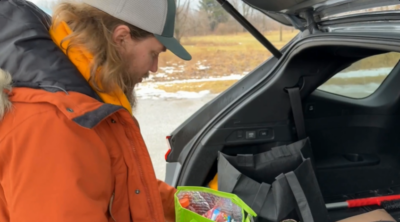
Dane Hansen fills his backpack with snacks and juice boxes to share with people experiencing homelessness.
At the office, the team walks straight into their weekly outreach coordination meeting — where outreach teams from four different organizations meet to ensure coverage across the entire county and identify barriers and opportunities to better support people experiencing homelessness.
The number of people living outdoors in tents and other makeshift shelters tends to decrease in the winter, but some temporary accommodations people move into also present challenges.
Some people are pooling their insufficient social assistance cheques to pay living costs for temporary accommodations that are in unsuitable states of repair.
In the meeting, teams share real-time updates, coordinate follow-ups, and divide tasks with a goal to help these people transition to safer options.
‘They know me by name’
Back on the move, the community outreach team swings by the HART Hub — one of 28 provincially funded Homeless and Addiction Recovery Treatment (HART) programs that provide a range of services under one roof.
Since the facility opened in late 2025, community outreach worker Vjollca Bramham says they’ve seen many new faces, people seeking support as more find themselves unable to afford rent, or in difficult housing situations.
But today, a familiar face greets the team at the door. Jason* has been on the housing waitlist for years already, cycling in and out of homelessness, often staying on couches at the houses of friends or family.
“I like that [the outreach team members] know me by name,” he said.
Jason said he has borderline personality disorder, and the outreach team is helping him apply for the Ontario Disability Support Program (ODSP), which has a higher maximum shelter allowance than Ontario Works — up to $599 per month for a single person.
Still, that often isn’t enough to afford rent, Jason said.
“Things are slow right now. Not a lot of housing,” he added.
‘Now I actually have time’
The lack of affordable housing kept Hailey trapped in homelessness in Sarnia for years, moving from one encampment to another.
“Social assistance rates are not enough to pay market rent, so you’re stuck waiting to get into social housing,” Hailey said.
And she wasn’t very hopeful about getting into community housing — the waitlist for a Rent-Geared-to-Income unit is more than four years.
“I was still trying to look for places that were market rent just as an option, because I’d rather give up my whole cheque than live in a tent,” Hailey said, adding she tried several times to find an affordable place to split with friends by pooling their social assistance, but couldn’t find an option that worked.
“It’s hard to just go and get a job, especially if you didn’t finish high school … and especially when you’re homeless, because sometimes leaving your tent and everything for so many hours to go to school or work, it’s just not doable because you’re going to come back and all your things are going to be gone.”

In February 2025, Hailey got the call there was a unit available, and she could take it if she wanted.
In February 2025, Hailey got the call there was a unit available, and she could take it if she wanted. By April, she had her own place to call home for the first time in three years.
“Now I actually have time to try and make my life a little bit better,” she said.
Since moving into her own home, Hailey says she has noticed her health improving, and she started looking into taking the Canadian Adult Education Credential (CAEC) to build her resume.
And Hailey isn’t stopping there. She’s knitting mittens to give out to people still sleeping outside in the cold, and has joined the county’s A Better Tomorrow committee, which is made up of people with lived experience of homelessness who meet monthly to share their expertise and help shape local homelessness programs and systems.
“It could happen to anybody. Lots of people are one bill away from being out there with us,” she said.
More affordable, supportive housing coming to Lambton
The stigma facing people experiencing homelessness can make it even more difficult to secure an apartment.
“As a single person, it’s next to impossible to find an apartment to live in, unless we can get people into subsidized units,” Hansen says.
“Sometimes, if a landlord hears that someone is on Ontario Works, they will just shut down. If they hear that you don’t have any housing history because you’re living in a tent, we won’t get a call back.”
Lambton County’s community outreach team is the first step in a coordinated system of support. Once there is an opportunity to move someone into housing, the County’s broader social services division helps with that process.
Even in a challenging market, people are moving into homes. New, affordable units are being built, and more supportive housing is coming to Lambton County.
As that progresses, Lambton County’s community outreach team will continue to help people experiencing homelessness organize their documents, apply for waiting lists, and find safe and affordable housing wherever they can.
*This Bright Spot is funded by the Government of Canada.