
For the vast majority of people who experience homelessness, all they want and need is a home they can afford, that meets their needs.
Some people struggling with physical or mental health challenges, or substance use disorders, will need supports to recover. Housing-related and other supports can be offered in the community, in private market rentals or affordable housing through Housing First programs—known as scattered-site housing first programs.
But some people—including those struggling with very complex needs like brain injury, cognitive impairment, severe addiction or multiple co-morbidities—will need a more intensive level of support in specially designed housing.
That is supportive housing.
Rather than living independently with additional assistance, supportive housing is a building with multiple units that have supports present right there in the facility, in most cases, operating 24 hours every day.
This means people who need more intensive, wrap-around support have it available all the time right in their homes. The supportive housing operator, or the “landlord,” also tends to be more willing to work through challenges that could otherwise lead to housing destabilization or even eviction.
Supportive housing centres the core belief that everyone deserves a safe and decent place to call home. People do not need to earn housing or be made “ready” for it—some people just need more support to be safe in their homes.
Who is it for?
Supportive housing is intended for people who:
- Are homeless or at high risk of homelessness;
- Have complex needs, and therefore face additional barriers to stability in traditional housing;
- Are not safe in scattered site housing first interventions, often due to behaviours related to substance use disorders, brain injuries, or developmental disabilities.
Crucially, it reduces the risk that someone will fall back into homelessness.
Why is it important?
1. Helps people find and keep a home
Many people experiencing chronic homelessness have long histories of housing instability, physical or mental health challenges, and other systemic barriers—which are exacerbated by the trauma of homelessness itself.
With a stable home plus supports, people have a chance to rebuild. In a study of supportive modular housing in Vancouver, nearly all (94%) residents remained housed six months after move-in and 89% were still housed after one year.1
2. Improves self-worth, social connections and health
When people have housing and supports, they can focus on their health, community participation, and meaningful activity—which contributes to overall well-being.
3. Makes economic sense
Supportive housing isn’t only an effective model for the people who need it, it also reduces costs for emergency interventions like ambulance, hospital and shelter services, and alleviates pressures on social, justice and healthcare systems.
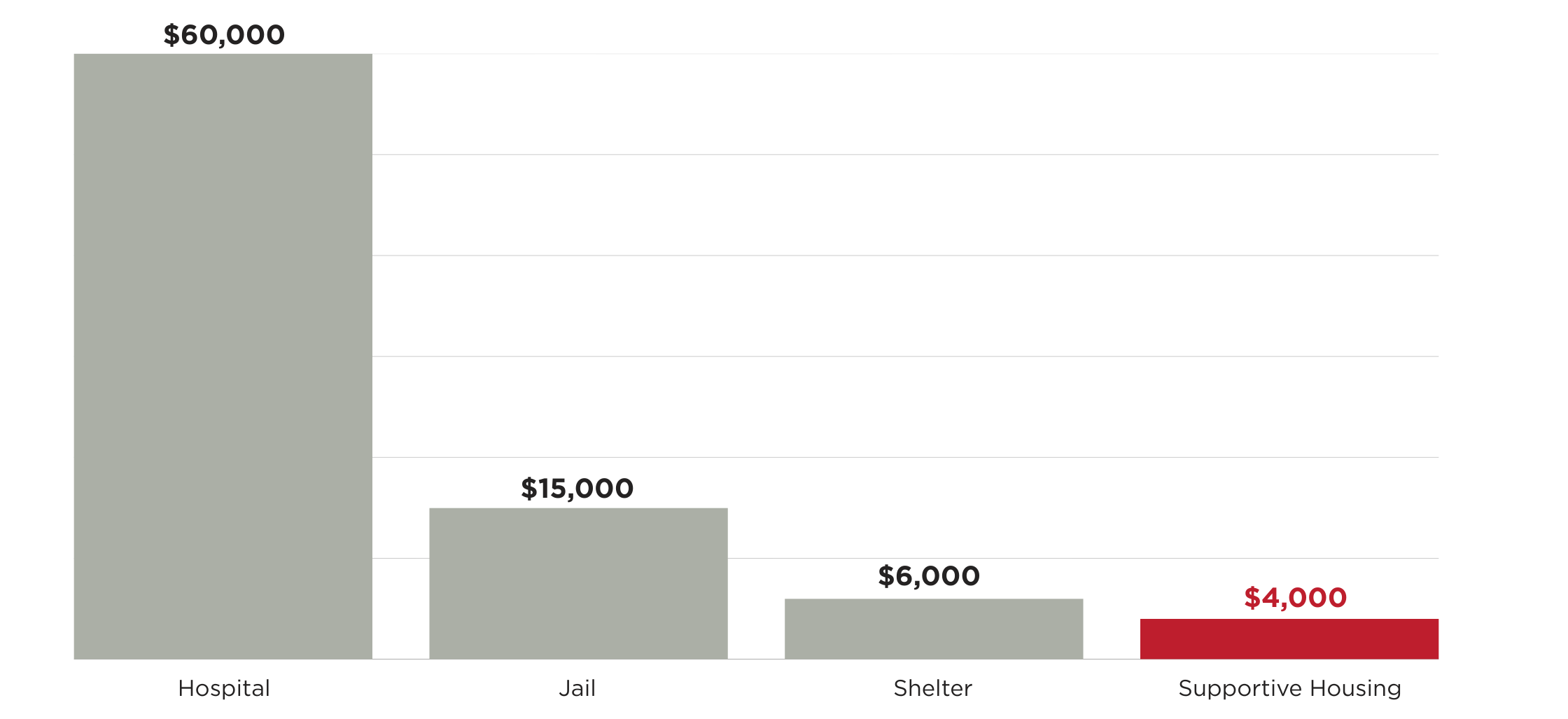
At Dunn House in Toronto, a 51-unit “social medicine” supportive housing facility, the monthly cost to house someone is estimated at $4,000. That’s far less expensive than the monthly cost for someone staying in a public hospital ($60,000), in a provincial jail ($15,000), or in a shelter ($6,000).2 Researchers found that local hospitals spent $1.66 million less on hospital stays for the 48 residents who suddenly had a home and direct health access once they moved into Dunn House. Importantly, the facility created permanent housing and supports for 51 people experiencing homelessness.
The case for supportive housing: Monthly costs housing people experiencing homelessness
4. Addresses community safety
Supportive housing creates a safe space for people experiencing homelessness to live. For those living with complex mental health needs or substance use disorder, it gives them regular and direct access to the health supports they require.
In St. Thomas, Ont., calls for police response in the city centre have dropped by 87 per cent in the year since a 15-unit supportive housing facility opened in the downtown core. Instead of having police responding to health crises, often related to complex mental health or substance use disorders, residents in the facility had access to the health services they need.3
To get it right, quality matters
One of the challenges in delivering supportive housing is that there are no national standards or guidelines—which can translate into supportive housing units that fail to meet the needs of residents, wasting resources and time in the urgent work to end homelessness.
Supportive housing should explicitly be for people with the most complex and long-term needs, which means the housing should be expected to meet rigorous standards.
These minimum standards should centre housing first principles, and ensure they are:
- Centring the needs of tenants, with the housing and support services designed and delivered in collaboration with them;
- Accessible for tenants of all backgrounds and abilities, so they can enter the housing quickly and maintain their housing for a long period of time. This means no conditions on housing ‘readiness,’ such as proving they are not using substances;
- Separating housing and support services, meaning tenancy is not tied to participation in the supports provided, which remain voluntary, individualized, and culturally safe;
- Operating with a high degree of cooperation between agencies providing the supports and services; and
- Designed and maintained so all homes are safe, sustainable and consistently providing high-quality services.
With so much investment flowing into the construction of supportive housing across Canada, now is the time for federal and provincial/territorial governments to develop clear standards and expectations for permanent supportive housing.
How we get there
Without more supportive housing, we won’t have the full set of tools required to end homelessness.
The move to prioritize supportive housing in the federal government’s Build Canada Homes initiative is an important first step, but with homelessness on the rise, we need to act with urgency and make sure new housing is well-designed and well-resourced.
That means:
- Federal/provincial/territorial collaboration to ensure the necessary supports and service integration for new and existing supportive housing projects. Without both the housing and the supports to build a stable life, we risk people falling back into homelessness.
- Developing federal-provincial-territorial standards and guidelines for supportive housing based on Housing First principles, to ensure investments in permanent supportive housing are successful.
- Ensuring that investments in supportive housing include clear, outcome-oriented targets to increase housing stability and deliver reductions in homelessness.
- Promoting partnerships between housing providers, health and social-service agencies, community organisations and Indigenous-led services to ensure the model works for diverse populations.
- Raising awareness in communities and neighbourhoods to build support, reduce stigma, and highlight that supportive housing benefits everyone—not just its residents.
Supportive housing puts the promise of a home in reach—not just as shelter, but as a place for recovery, stability, community, and dignity. For Canada to truly end homelessness, we must scale up supportive housing. Every home built, every support embedded, means one more person given a chance to live safe and connected.
Links for more information
For more information about housing first, supportive housing, and minimum standards and guidelines that bring these two complementary tools together, please visit the following resources:
- Canadian Housing First Toolkit — Canadian Alliance to End Homelessness
- What is Housing First brief — Mental Health Commission of Canada
- Quality Supportive Housing Standards — Corporation for Supportive Housing, USA
- Quality Supportive Housing Pre-Development/Planning Checklist — Corporation for Supportive Housing, USA
- Housing First Fidelity Principles Program Evaluation — Pathways to Housing
- Implementing Housing First in Permanent Supportive Housing — United States Interagency Council on Homelessness
- Permanent Supportive Housing Evidence-Based Practices — US Department of Health and Human Services
- Supportive Housing Evidence Briefs — Corporation for Supportive Housing, USA
Footnotes
1 Insights: What is supportive housing, who is it for, and how does it work?
2 Toronto ER costs, visits by frequent patients reduced with new housing model | CBC News
3 Core police calls plummet after St. Thomas housing facility opened | London Free Press