
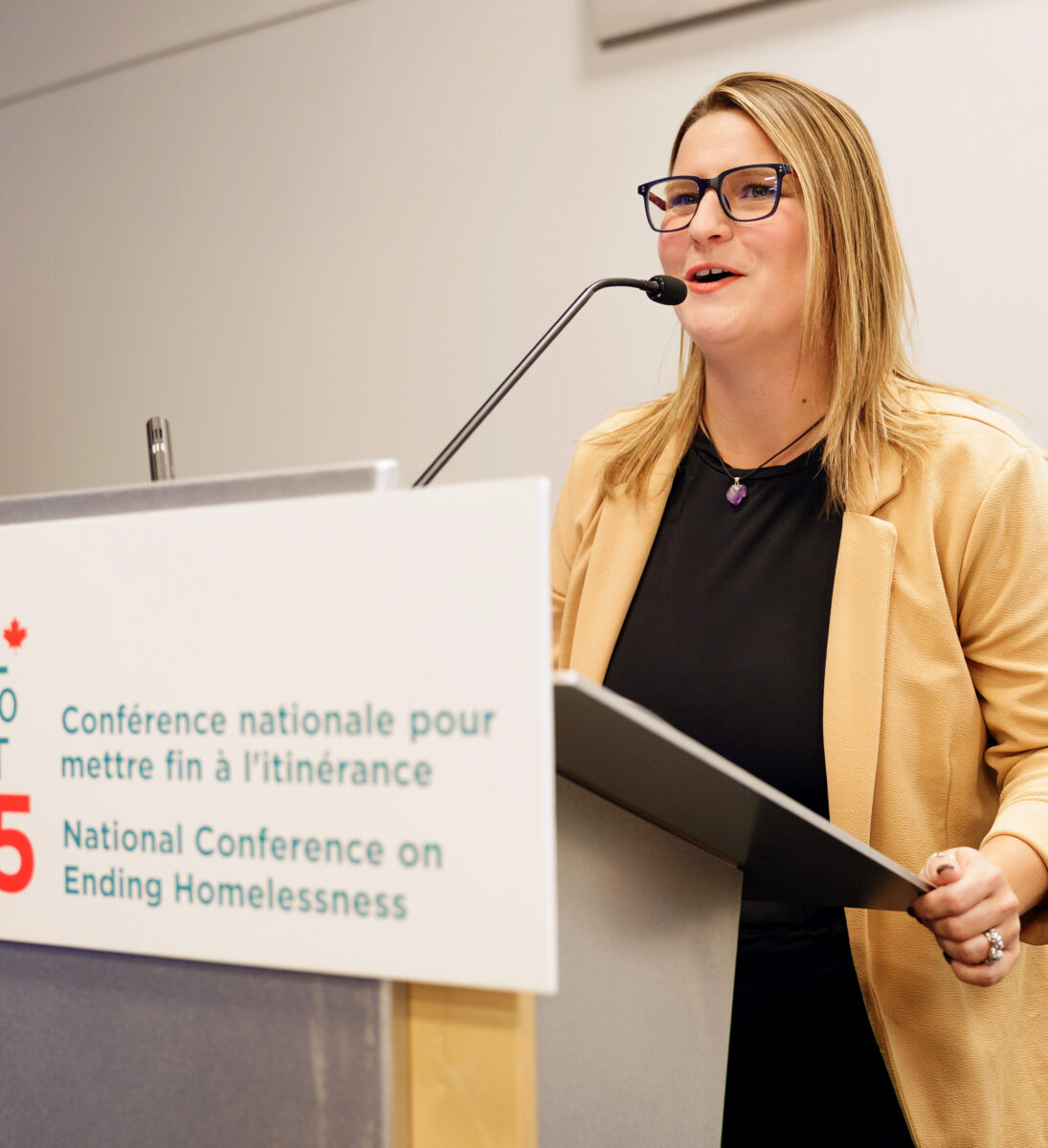
 Looking out at a sea of listeners, Jacinta Brown of Prince Edward Island’s Community Outreach Centre asked people to stand if they felt they were collaborating well with the medical field.
Every seat in the conference room was filled with people coming from across Canada to attend the National Conference on Ending Homelessness in October 2025.
About a quarter of the room stood.
And how many are working closely with the justice sector? Brown asked. Only a handful got out of their chairs.
“Take a look around. Not many in the room are collaborating with justice. That’s telling,” she said.
“Those are big gaps that you’ve just now identified in your communities and can start taking some really targeted approaches to bridging.”
In Prince Edward Island, there is one coordinated access table for the entire province, bringing together a range of agencies working together to identify, support and find housing for an average of 289 people actively experiencing homelessness every month.
Bringing sectors to the table
After a multi-year mission to break down the siloes between agencies, there are now organizations representing 11 diverse sectors sitting at the coordinated access table, said Josh Constantinou, the Coordinated Access Coordinator with the John Howard Society of PEI.
That includes Indigenous partners, corrections, medical, addictions, mental health, education, political leadership, employment and tax system, child and family services, and social programs.
This creates a comprehensive set of agencies ready to pitch in and ensure people have all the tools they need to find and keep a safe and decent home.
It also means people experiencing homelessness have a one-stop-shop to get access to resources, and don’t need to navigate multiple systems or waitlists on their own, re-telling their story and journey to each agency.
But it wasn’t easy to reach this level of collaboration.
The first step, Constantinou said, was to gather the people that were already interested in being part of the coordinated access table and then see how to add one more person, one more sector at a time.
“Think about the benefits from the other person’s perspective. Don’t think: what can this person bring to us? Think: why would they want to come and be a part of this from their perspective, and how can it benefit them?” Constantinou said.
Sometimes, that meant identifying data that shows the link between different sectors. It’s how Constantinou says they were able to bring the corrections system on board.
“Most people, whether frontline or in management, don’t want to see the same people coming back. That’s a shared goal, and we know that one of the pillars of the federal framework to reduce recidivism is housing—so there’s an opportunity to collectively support individuals to not re-enter correctional facilities after being discharged,” Constantinou said.
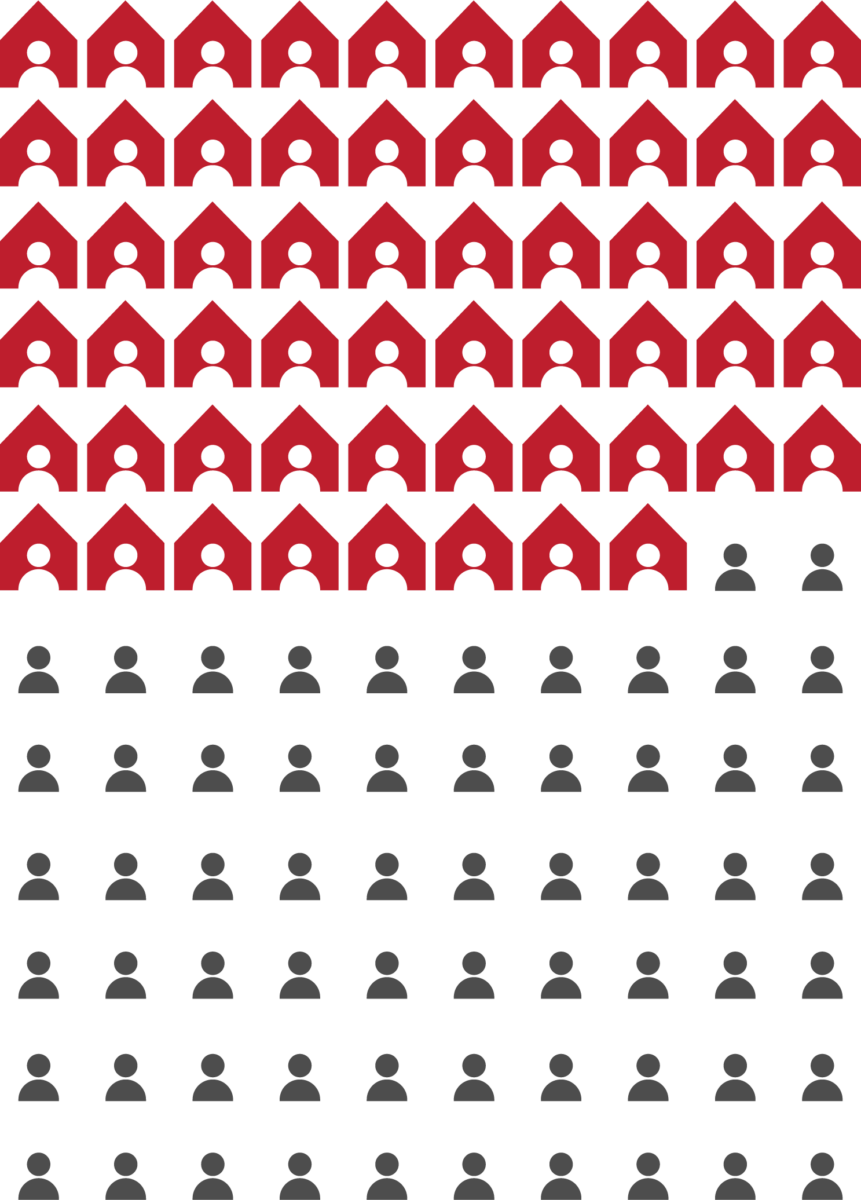 During the 2024 Point in Time count, Constantinou says they worked with the Provincial Correctional Centre to ask the roughly 120 people who were incarcerated if they have a permanent place to live when they’re released.
There were 62 people who responded to the survey saying they had nowhere to go.
“That was the first step to help the corrections sector realize internally that it’s a big number of folks. The prevalence of homelessness is very high. And that introduces a very tangible, realistic conversation starter,” Constantinou said.
They built on that information and relationship. Now, as part of the John Howard Society of PEI’s wraparound housing program, there is a dedicated housing and homelessness case manager based primarily in the provincial correctional centre meeting with people before they’re discharged to provide a range of supports including identification, employment and housing options, and connecting them to social assistance.
Overcoming resistance to joining coordinated access
The community had a very similar approach to engage with the medical system, conducting a health survey with people experiencing homelessness, Jacinta Brown said.
The survey identified that more than 80 per cent of the participants were experiencing co-morbid or tri-morbid mental health diagnoses.
“These are people experiencing substance use disorder, mental health challenges, chronic medical conditions, and on top of that, they were unhoused,” Brown said.
While it helped bring the medical field to the table, there were some challenges getting a representative from the substance use system.
“We had tried to get them on side for a very long time, but there were concerns around that happening. We knew that was the target, but when we couldn’t hit the target, we looked around at what existed within the same sphere,” Brown said.
They found several other programs working in the same area and were eventually able to bring on board the supervisor of a transitional unit for people exiting an in-patient substance withdrawal centre.
“He was eager, and he agreed. And as soon as he was at the table, all his colleagues in similar programs started asking, ‘well, if he’s part of it, shouldn’t we be part of it?’” Brown said.
“All you need to find is the one program or the one individual who is going to be your shining star in that sector that you want to collaborate with.”
Bringing organizations together with HIFIS
The collaboration doesn’t end with coordinated access.
Agencies across these sectors also contribute to the Homeless Individuals and Families Information System (HIFIS)—a data and case management system that allows participating agencies in the same community to access, collect and share local, real-time homelessness data to ensure people experiencing homelessness are prioritized and referred to necessary resources.
Usually, HIFIS includes many modules, allowing housing providers to input information about someone’s medical history, mental and physical health, medications.
This can help get someone matched to a housing unit that has the supports they need to be safe in their home.
But in PEI, they’ve removed most of the modules, limiting the information in HIFIS to the minimum needed to house people appropriately.
“We’ve changed the approach from ‘you’re either in or you’re out,’ to ‘here’s what we’re asking and looking for, and the minimum we need from you to help us continue to care and support a person experiencing homelessness,’” Constantinou said.
Without this kind of collaboration, if, for example, someone was incarcerated, they would lose contact with the agencies supporting them and fall through the cracks.
“While somebody is in the community, we can do a lot of good work with them, but if they become incarcerated or go into detox or are admitted to a hospital and we lose contact for weeks or months, we lose a lot of progress,” Constantinou said.
“The more we can try to find a way to extend that continuity of care, the better the outcomes will be.”
The consent form that people experiencing homelessness sign when they agree to have their information recorded in HIFIS allows agencies to record and share their housing history—such as if they are staying at an emergency shelter or an in-patient treatment program—but it doesn’t allow agencies to share what kinds of treatment or supports are being offered.
It means connections can be made, without having to worry about additional privacy concerns and challenges.
Why this matters
Prince Edward Island is a relatively small area, as compared to many other regions and communities working to end homelessness.
But the work they’ve done to bring a diverse range of sectors together and break down siloes is impressive, says Dawn Wheadon, the Canadian Alliance to End Homelessness’ lead Improvement Advisor for PEI.
“There are many communities across the country that are struggling to get collaboration from sectors or community organizations that aren’t mandated to collaborate by their funders,” Wheadon said.
“But PEI has shown you don’t need to have it all figured out before you start. Begin with who you do have at the table, and use the tools provided by CAEH to formulate a working plan to expand.”
PEI’s work to better understand the people entering and exiting homelessness, and their use of data to advocate to governments and bring sectors together is particularly remarkable, said Wheadon.
“When we work as a community using the data to guide our next move, and make an effort to move away from our historical approach of ‘my clients, my program,’ to ‘our clients, our program, our community, our responsibility,’ we start to see results,” she said.
Still, PEI isn’t done yet in their work to expand the cross-sectoral collaboration.
They have their sights set on engaging with emergency medical services, Jacinta Brown said.
And she says there’s still a long way to go engaging with landlords and the public to shift public opinion so that everyone believes homelessness is solvable.
This project was funded by the Government of Canada.