
Key Takeaways for Communities
-
An initial scan of existing services and gaps can show opportunities for innovation and improvement. When designing their Homelessness Reduction Innovation Fund project, PEI identified a gap in addressing youth homelessness and created a project that found its niche while complementing existing programs.
-
Structural barriers like high rental prices and limited affordable and non-market housing pose challenges but also create space for innovation. To increase move-ins, PEI adapted and cultivated positive relationships with private landlords, who became interested in opening their units to more youth.
-
Relationships with high schools, family child services, and youth corrections can help identify youth under 18 who are experiencing homelessness and require support.
- Early lessons learned from this first round HRIF project highlighted another gap in the system—preventing people (and youth especially) from re-entering homelessness after finding housing. This led to the development of PEI’s second round HRIF project.
The first time she walked into her one-bedroom apartment, Jayden fell to the floor.
“I was just really happy to have my own place … I can touch everything. It’s my floor. It’s my place,” she said.
The moment Jayden, 20, got the keys in October 2025 marked the end of a long period of homelessness and housing instability in her young life.
“I’m not worried about where to put my stuff, and where I’m going to sleep. I know that I can wake up in the morning, get ready, smell good, look nice, and go to college,” said Jayden.
“I can do all my work, and I know whenever I come home, I’m going to have a nice, warm place to go.”
Jayden got the support she needed from the Youth Wraparound Housing Program, a partnership between the Canadian Alliance to End Homelessness (CAEH) and the John Howard Society of Prince Edward Island (PEI) to increase the number of youth moving from homelessness into housing every month.
It was funded through the $45-million Government of Canada’s Homelessness Reduction Innovation Fund (HRIF), delivered by CAEH, which supports data-driven improvement projects that aim to measurably reduce homelessness at a population level, while developing lessons that can support similar efforts across Canada.
The Youth Wraparound Housing Program received $328,000 to hire two full-time youth caseworkers to work directly with youth, a community engagement housing specialist to build relationships with landlords and mitigate tenancy concerns, and short-term financial supports to address barriers that young people experience to find and maintain housing.
The project aims to reduce youth homelessness by helping an additional 11 youth move from homelessness to housing over the course of the year.
Three-quarters of the way through the project, the team already supported 19 youth to exit homelessness.
‘Makes me feel like someone actually cares’
Jayden first became homeless at 14, struggling with her mental health and in her relationship with her mother and stepfather.
“I ended up leaving home because I was like, ‘I can do it myself. I’m strong and old.’ And I ended up living outside in the middle of January for a month and a half,” she said.
There was a lot of couch surfing over the next few years, until Jayden got involved with the youth justice system, and started living at a group home.
At 19, Jayden ran away to the United States.
“I left with someone who I thought was a good person. I ended up homeless. It was terrifying. Very scary. I didn’t know anything about America. I didn’t have money. I didn’t have anything. It was just me and my dog,” she said.

Jayden got the support she needed from the Youth Wraparound Housing Program.
Eventually, Jayden got support to return to Canada, and moved back in with her mom and stepfather, until her parents separated and Jayden began couch surfing again.
During that time, she attended a life management program for youth, and later went to the REACH Foundation in Charlottetown, which offers programming for youth to focus on their mental health and gain employment skills, working at the in-house social enterprise. That’s when Jayden was referred to the John Howard Society’s Youth Wraparound Housing Program.
Steshonia Hall, one of the youth housing caseworkers hired to the HRIF project, helped Jayden get connected to income assistance in PEI, and eventually find apartment.
“If I have a problem or anything happens, I can call her up immediately, and she’ll do her best to help me. When we were looking for these apartments, she came over at like 8 p.m., like she was never off the clock,” Jayden said.
“I didn’t have that kind of support growing up, so having that support now, it makes me feel like someone actually cares,” she said.
Wraparound support, landlord relations critical components of project
Hall says she wants young people in PEI to know they’re not alone. If they’re experiencing homelessness, the team at John Howard Society of PEI is ready and equipped to help, she said.
“You might be going through this difficult experience, but it’s not a life sentence. We are here to give you this opportunity to find a sense of direction and purpose that can transform your life,” said Hall.
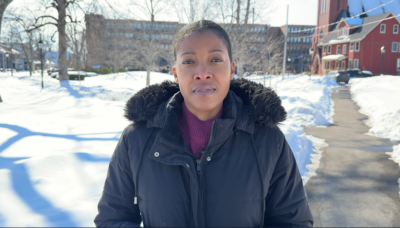
Steshonia Hall is a youth housing caseworker hired to the HRIF project.
As a youth caseworker, Hall says her job is to help youth find housing, but the support doesn’t end there.
“There are possible underlying issues impacting them and could contribute to how they’re able to maintain housing. We’re preparing youth to stand on their own two feet … so they’re able to identify where, when, and how to access resources while they maintain that rental and their independence,” she said.
Finding housing that’s affordable is a challenge, said Josh Constantinou, the Coordinated Access Coordinator for PEI with the John Howard Society.
Social assistance rates are not on par with the cost of living, and investments in new affordable, supportive and non-market housing have not yet addressed the high cost of rent nor the astronomically low vacancy rate, he said.
“We can’t sit around and wait for that to happen. It requires getting creative and looking for opportunities to maximize partnerships or the pathways that might exist.”
The project team has newly started engaging with private landlords in a very targeted way, to identify more affordable units that could be made available for youth to rent. Constantinou said two new elements have helped the team build strong relationships.
First, they drafted an agreement document that’s shared with potential landlords to clarify the supports that John Howard staff can provide, and how everyone can contribute to a successful tenancy. This has created open, transparent conversations with landlords interested in renting to young people, Constantinou said.
Youth participants in the wraparound housing program also have the option to share an anonymous bio with potential landlords, including information about their housing history, family situation, hobbies, or education and employment goals, to add a more personal element for the landlords to consider.
The project follows Housing First principles, so the anonymous bio is not mandatory, Constantinou said. But there has been a very positive response from landlords.
“When you don’t know the tenant that you’re getting, sometimes your brain jumps to worst case scenario, and they think of all the terrible experiences they’ve had in the past and the horror stories they’ve heard … but with more information, the landlord becomes way more open and receptive,” Constantinou said.
He added they’ve already had so many positive experiences, several private landlords are interested in renting to additional youth, to help them exit homelessness.
Early lessons lead to a second HRIF project
When the John Howard Society started looking to develop an HRIF project with CAEH in early 2025, there wasn’t a lot of data on youth homelessness in PEI, Constantinou said.
At first, Constantinou said they wanted to create a youth homelessness project that was all-encompassing, addressing homelessness prevention, housing, and post-housing supports.
But with the support of CAEH improvement advisors, Constantinou said they looked closer at the By-Name Data, a database with timely information about who was entering, exiting and actively experiencing homelessness.
They found that zero youth exited homelessness over the prior four months.
“We weren’t seeing any movement. We weren’t able to successfully secure and find housing for youth … so our improvement advisor helped us hone our project a little more and focus on one element: move-ins,” said Constantinou.

Josh Constantinou is the Coordinated Access Coordinator for PEI with the John Howard Society.
The project staff built relationships with organizations already working with youth — from family and child services to youth justice services to student well-being teams in high schools — and started receiving referrals of youth experiencing homelessness.
But they also received referrals of youth precariously housed and facing homelessness, who technically were not eligible for a youth project targeting move-ins. Targeted prevention and diversion was a clear gap in their services, Constantinou said.
In January 2026, PEI successfully launched the Prevention and Diversion Program, a new project, funded during the second round of HRIF applications, to provide short-term financial support and case management to people who exited homelessness in the past three years, but are now at risk of returning to homelessness.
“What we’ve found already is when you pair the financial piece with support, they can be successful on a longer-term basis in maintaining their housing,” Constantinou said.
The provincial government had previously supported a similar project. With the development of the new HRIF-funded Prevention and Diversion Program, renewed conversations between the John Howard Society and the province resulted in an additional $100,000 provided to increase funding and directly help more people experiencing homelessness.
These two projects are great examples, where PEI has identified gaps in their homelessness response system using timely By-Name Data and is working with CAEH to test ideas with data-driven projects to reduce homelessness, said Dawn Wheadon, CAEH’s lead Improvement Advisor for PEI.
“I’m incredibly proud of the work PEI has done and continues to do. This is exactly the intention of the Homelessness Reduction Innovation Fund: to bring a community together with the shared goal of reducing homelessness, test an idea with a data-driven project, and innovate to maximize impact,” Wheadon said.
“The projects have led to new cross-sectoral collaborations and brought multiple levels of government together to urgently address the crisis of homelessness. That’s what we can do together.”
This Bright Spot was funded by the Government of Canada.