
 *Content note: This story contains mention of suicide.
At first, it was anecdotal.
Emergency shelter workers across the Niagara region noticing a few more seniors showing up at night, without anywhere else to go.
Then, the By-Name Data — a list of all people actively experiencing homelessness in the region — confirmed it.
Seniors now represent 15 per cent of all people experiencing homelessness in Niagara, and the number of seniors experiencing homelessness for six months or longer is rising steadily.
Many had fallen into homelessness for the first time in their lives. They were getting stuck, unable to find an affordable, suitable place to call home and forced to stay in tents outside, in encampments, in cars, or in shelters.
In many cases, staff working with seniors are finding their clients’ needs are more complex than most, with complicated health issues, extensive medication regimens, cognitive decline, accessibility challenges, limited financial means, and carrying a lot of shame.
To respond to this reality, the Canadian Alliance to End Homelessness (CAEH) and the Regional Municipality of Niagara partnered to create the Aging with Dignity project, funded through the Homelessness Reduction Innovation Fund (HRIF) — a federal Reaching Home initiative led by the Canadian Alliance to End Homelessness (CAEH) to support innovative projects that rapidly and measurably reduce homelessness in communities across the country.
In the first six months of operation, Aging with Dignity has helped 15 seniors find a permanent home.
By the end of 12 months, this project aims to more rapidly connect seniors experiencing homelessness with safe, permanent housing, which will ultimately reduce chronic homelessness in the region by four per cent.
“It’s not just about housing. It’s about the accessibility of what they have to support their everyday independence … how can we support not only their physical well-being, but also respond to the emotional toll that comes with being newly homeless,” said Bronwyn Campbell, a social worker with Aging with Dignity.
Aging with Dignity created a multidisciplinary team of three clinical and non-clinical community-based workers to provide a full suite of support, from financial and housing support to referrals to community agencies, to mental health counselling.
The team has access to a flex fund they can use to support clients and offers 90 days of support for seniors after they’ve moved into their new housing.
“We’re not just short-term planning. We’re making sure whatever plan we’re putting in place is actually supporting people to age with dignity and maintain their level of independence and support as they get older,” said Campbell.
‘This program was our lifeline’
There are many reasons why seniors are falling into homelessness, says Jasmine Winger, a community worker with the Aging with Dignity team.
Stories pour out of her.
One client started having difficulties with her memory, which meant missed rent payments, arrears and ultimately eviction. Others were renovicted or couldn’t afford rent after a family breakdown or a death in the family.
There are lots of medical issues, Winger says, whether it’s a long, unexpected medical admission and discharge into homelessness, or a couple where the primary income-earner becomes gravely ill and their income to pay rent disappears.
“A lot of it comes down to the financial… not knowing where to go at the end of the day for supports. A lot of seniors haven’t had to access supports for most of their lives because they’ve been able to maintain their housing and independence, until something happens,” said Winger.
Once they become homeless, the biggest challenge, Winger says, is finding a place that is both affordable and accessible.
“Often when I chat with someone about their ideal living situation, a lot of folks will say, ‘I’m looking for a bachelor or a one-bedroom for anywhere between $700 and $800 a month,’” said Winger.
“That was the rental price 15-20 years ago. I have to inform them of the harsh reality that we’re now looking at much higher rental prices, maybe $1,700 to $1,800 per month. It’s a big shock for a lot of them, and their first question is, ‘how am I going to pay for that?’”
Winger says that’s where her and her colleagues come in, helping seniors work through their financial and housing options, offering counselling to heal from the trauma of experiencing homelessness, and ensuring a smooth transition into their new home.
“I became homeless unexpectedly, and it felt like my life was falling apart. I carried a deep sense of shame and uncertainty. At times it felt like this was the end for me. When I found out I was being connected to this program, things finally started to come together. I found the hope I had been desperately looking for.”
— George*, supported through Aging with Dignity
Elisabeth* said her life now is very different from when she didn’t have housing.
“I wasn’t making the best choices around the people I was associating with, and I was using substances, which was leading me down a path I didn’t want for myself,” said Elisabeth.
“Being part of the program meant I could regain my independence and feel secure in my day-to-day life. I feel more stable and supported, and I’m able to focus on my health and my relationships. I’m attending all my medical appointments and taking steps to get both my physical and mental health back on track,” she said.
Early intervention is critical
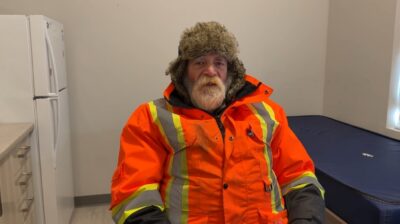
Paul, who recently moved into his own apartment after being supported by Aging with Dignity
Paul says he still doesn’t understand why he was evicted from his apartment two months earlier. But when he was forced to leave, he ended up in a shelter, where he met Jasmine and the rest of the Aging with Dignity team.
“For the first couple of weeks, it was rough. I tried to commit suicide. I had a couple people over at the shelter talk to me, and I had Jasmine talk to me, saying that if I needed something, don’t be afraid of asking,” Paul said.
Still recovering from a broken hip, Paul said it was difficult staying at the shelter because it isn’t set up for people with accessibility needs, and he had to leave his power wheelchair outside in the cold weather.
Once onboarded with Aging with Dignity, Paul moved to a short-term Bridge Housing unit while he receives ongoing support to arrange his finances, apply for affordable and accessible housing, and determine what additional resources he needs to maintain his independence.
“I’m just trying to get back in the swing of things again. Hopefully I can get a place soon,” Paul said.
“Emerging literature suggests that older adults experiencing homelessness for the first time are at greater risk of adverse outcomes, health decline, and premature mortality than those who are chronically homeless. This is due to rapid health decline and less resilience to the effects of homelessness and navigating the system,” said Emily Liefl, Outreach Services Manager with Senior Services at the Niagara Region.

Emily Liefl
“And we are seeing older adults becoming more disconnected from their community, with exit options becoming far more limited,” said Liefl.
“That’s why the HRIF project is focused on early intervention. Helping older adults find stable and appropriate housing quickly is so important, so they can access health supports and other social services within the community, before the impacts of homelessness become even more challenging to recover from,” Liefl said.
Project continuing to evolve and improve over time
Since the project started, Niagara Region has already learned a lot about how to better support seniors recently falling into homelessness, says Prabhjot Kaur, community services specialist with the Niagara Region’s Homelessness Services.
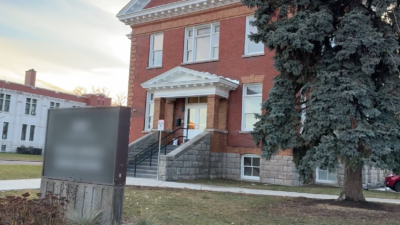
Wayne Campbell Building
Those lessons have led to some pivots and improvements in how the project is delivered.
The longer that seniors spend experiencing homelessness and staying in shelters, the more rapidly their cognitive and physical health deteriorates, Kaur said, meaning the kinds of supports they require in their permanent home can be constantly changing.
It also can take a long time to help seniors find permanent housing when they have complex health issues that require frequent or long-term hospital stays.
As the first few months of the project unfolded, Kaur said, “we realized that we were capturing individuals later on in their journey to homelessness … people showing up on our By-Name Data three months after they first started experiencing homelessness.”
So, the Region supported learning across the homelessness response sector to ensure seniors were being referred more quickly to the Aging with Dignity project.
The region also shifted its eligibility criteria. Instead of referring seniors to the specialized program after two months of experiencing homelessness, “we moved the criteria to capture these individuals on day seven,” said Kaur.
Iterative continuous improvement is a core Built for Zero-Canada methodology that’s critical to making reductions happen in community, including in HRIF projects, says Chantal Perry, CAEH’s lead improvement advisor for Niagara region.
“What stands out most is Niagara’s commitment and competency in approaching this as a formal continuous improvement initiative— actively testing and implementing strategic changes, while systematically capturing data, documenting lessons learned, and refining processes in real time. This disciplined approach not only improves current housing pathways for seniors, but also builds a scalable evidence base that can be used to inform broader system transformation,” Perry said.
Kaur says now is a pivotal moment.
“Seniors are a rapidly increasing demographic in Niagara, and we’re seeing that same growth in the population experiencing homelessness. Five years down the road, the proportion of seniors experiencing homelessness may continue to grow, and we need to be prepared,” said Kaur.
This project is funded by the Government of Canada.