

by Mitch DeCock, Data Lead
You can’t improve what you don’t measure. That’s why the Canadian Alliance to End Homelessness (CAEH) works directly with communities across the country to reliably track the number of people experiencing homelessness using by-name data. This is a comprehensive database of all people experiencing homelessness in each community, updated in real time and collected with the consent of each person.
Built on international best practices, the CAEH approach is being used in more than 60 municipalities across the country.
It’s a revolutionary step forward, as compared to how homelessness is otherwise tracked—a static Point-in-Time Count that happens annually. Instead of giving an infrequent snapshot, by-name data gives community agencies constant information about how homelessness is changing on a nightly basis, and what’s needed to respond now.
At the core of this by-name data approach are what we call inflow, active, and outflow metrics. Communities use inflow data to understand who is entering homelessness, active data to manage their current caseloads and service needs, and outflow data to track progress toward housing. The information can be broken down even further by population and subpopulation, including youth, veterans, and those experiencing chronic homelessness.
Together, these metrics form the operational heartbeat of homelessness response systems across Canada. It’s the foundation to end homelessness in Canada. And we know it’s working—even if it doesn’t always look like it.
Proven Results: The difference we’ve made and the need to scale up
Across the country, homelessness has grown considerably since the COVID-19 pandemic. There simply aren’t enough deeply affordable housing options, and people are struggling under the weight of inflation and a challenging economy. Many people have lost their homes and been forced into homelessness. But there is progress to help people get back into safe and stable housing.
Since 2015, the CAEH approach has provided support to communities as they’ve moved people from homelessness into housing more than 97,200 times (Update! As of October 24 this number has grown to over 100,000). We call these instances “move-ins,” and communities that work with CAEH track and share move-ins monthly, as well as the number of people currently experiencing homelessness.
Of the 62 municipalities using our data systems, 49 have achieved quality data—a recognition that their monthly data is consistently accounting for at least 90% of the people actually experiencing homelessness in their community. In these locations, we can see that the number of people moved into housing that have not returned into homelessness in that community is far greater than the number of people currently experiencing homelessness.
Without this coordinated homelessness response, the crisis would be far worse.
And the impact on the ground is even bigger. With many shelters in communities already full, some of the people moved into housing would otherwise have been pushed into sleeping outside or in encampments. That would mean scarce resources being pulled into constant emergency measures, like cold weather response, instead of going toward lasting housing solutions.
Still, we know more needs to be done.
Canada is entering a pivotal moment in the effort to end homelessness. Federal leadership is advancing long-overdue policy shifts to improve housing affordability—reducing the number of people entering homelessness in the years ahead. At the same time, the homelessness response sector is becoming more coordinated, data-driven, and operationally mature than ever before.
There’s a clear path forward: fewer people entering homelessness, more people exiting, and a system ready to scale what works. We’re making sure communities are ready to seize the moment.
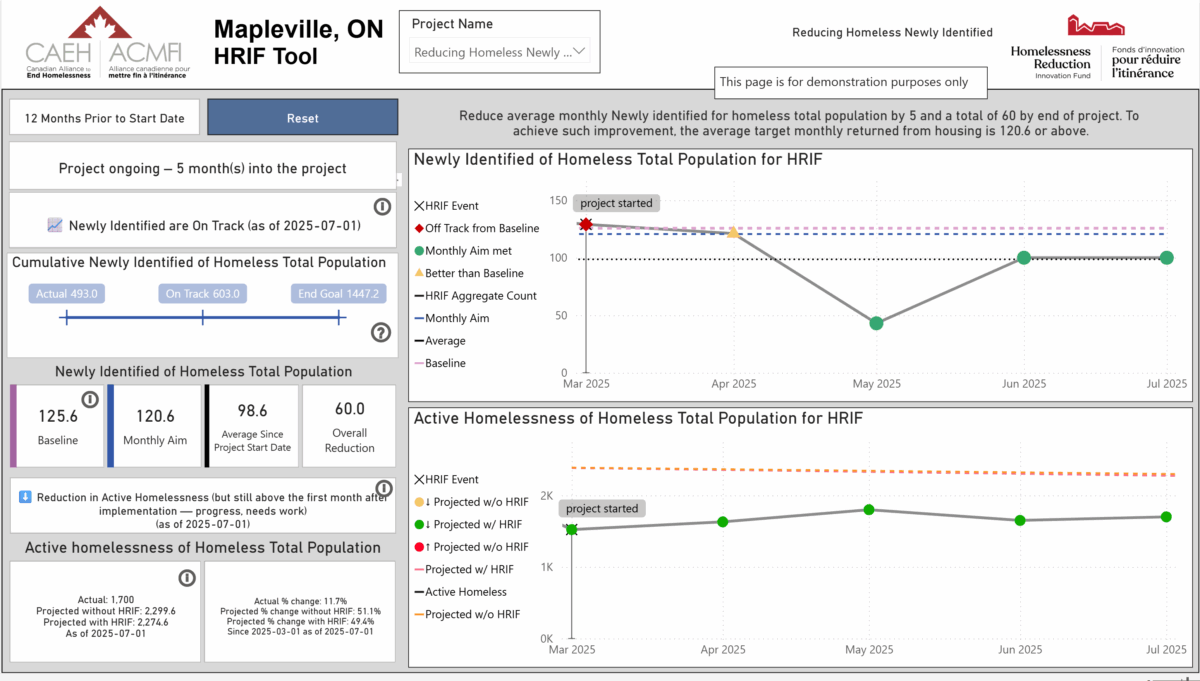
Sample data dashboard for a Homelessness Reduction Innovation Fund community
Fueling the Movement: CAEH’s Role in Accelerating Progress
CAEH is supporting communities to equip themselves with the tools, knowledge, and infrastructure they need to accelerate the number of people moving from homelessness to safe and stable housing.
We’re focused on outcomes-based, actionable data.
Too often, communities are expected to enter data into systems designed for tracking activities, not outcomes. We’ve flipped that model to count down the number of people experiencing homelessness until it’s ended. Everything communities share with us is immediately visualized in real-time on their dashboards, and then they can use that data to act.
We’re building tools communities actually want to use.
Our tools are co-developed with community input and refined through iterative development—meaning they get better with every use, every conversation, and every update. Communities tell us what they need to set goals to reduce homelessness and track their progress, and we build it together.
Real-time learning is now possible—and visible.
For the first time, communities across Canada can view the impact of targeted homelessness reduction projects and adjust responses in real time—seeing their goals, timelines, and results live on our dashboards. Today, this technology supports communities working on projects funded through the Homelessness Reduction Innovation Fund (HRIF)—a federally funded initiative that will improve homelessness response systems and achieve measurable reductions in homelessness.
We’re enabling new, intelligent investment in solutions that work.
The funding for HRIF projects will last until 2028. But the impact of this work will continue to be transformative in how homelessness solutions are financed. Through our tools, communities can easily and independently set time-bound, data-driven reduction targets—encouraging investment in projects evaluated by their outcomes. Equipped with real-time, trusted data, funders can now align their resources with what’s working.
Building Public Trust and Driving Transformation
In the past, we leveraged our national perspective on homelessness data to advocate for policy change and generate investment. Now, with the consent of those involved, we will share the stories of people with lived experience and highlight the efforts of communities to a national audience—sharing clear, operational data and best practices that demonstrate the impact of having a coordinated homelessness response system.
Canadians already agree that everyone deserves a home; these stories will strengthen public confidence that our collective movement is working.
While we’re not yet fully there, we are actively developing infrastructure to help communities tell their stories with data. Whether through public campaigns, political briefings, or staff meetings, our goal is to support communities in communicating clearly, confidently, and credibly to all audiences that ending homelessness is possible.