
Key Takeaways for Communities
- Building relationships with landlords can expand the housing options available to people experiencing homelessness. Recognizing there was an inadequate amount of non-market, supportive and deeply affordable housing units to meet the local need, the Regional Municipality of Wood Buffalo leveraged support from the Homelessness Reduction Innovation Fund to establish a landlord liaison role in the community. By developing and maintaining relationships with landlords, they’re making better use of market housing already available in the community.
- People with very low incomes often can’t afford even the cheapest market rentals, but flexible financial assistance, like housing benefits, can bridge the affordability gap. Through the municipality’s HRIF project, timely and flexible housing benefits remove a critical affordability barrier at the moment an individual is seeking housing and creates time to explore longer-term income and affordability options.
- Supporting people after they move in is an important part of reducing returns to homelessness. Housing coordinators based in Fort McMurray continue providing intensive case management to build housing stability, help people advance personal goals, and intervene in at-risk tenancies to prevent housing loss. When a tenancy cannot be sustained, workers quickly help people secure another housing option to prevent a return to homelessness.
- This HRIF project has helped the municipality double the average number of people exiting chronic homelessness every month. However, while outflow has increased, the municipality’s data shows inflow into homelessness has also increased. In the spirit of continuous improvement and a relentless focus on reducing homelessness, the municipality and CAEH partnered on a second HRIF project aiming to address inflow. This serves the goal of reducing chronic homelessness overall.
Jennifer Pittman’s job is to advise the Regional Municipality of Wood Buffalo how they can help more people exit homelessness faster.
As a social program advisor for the regional municipality, which covers Fort McMurray and nine hamlets, Pittman looks at the entire homelessness response system, identifying opportunities for improvement and the resources needed to reduce and ultimately end homelessness.
Ending homelessness isn’t a new concept for the community.
In 2023, Fort McMurray-Wood Buffalo ended homelessness for all veterans. Supported through Built for Zero–Canada, the municipality achieved Functional Zero Veteran Homelessness, which they continue to maintain, ensuring homelessness is rare, brief and non-recurring for anyone with veteran status in the community.
Now, the municipality has set its sights on reducing chronic homelessness.
When applications opened for the first round of funding through the federal Homelessness Reduction Innovation Fund (HRIF), the community was eager to apply.
HRIF is a $45-million Government of Canada fund, led by the Canadian Alliance to End Homelessness (CAEH), which supports data-driven improvement projects that aim to measurably reduce homelessness at a population level, and develops lessons that can support similar efforts across Canada.

Jennifer Pittman is a social program advisor for the Regional Municipality of Wood Buffalo.
“Going over our homelessness data every month with our CAEH improvement advisor really helped us sharpen our focus on what sort of project we wanted to do … she was always there to give us ideas on what we could improve, and her support was pivotal in getting approved for the project,” said Pittman.
A key challenge to helping people exit homelessness is limited availability of nonmarket, deeply affordable and supportive housing options in Fort McMurray-Wood Buffalo. The private market units that are available are often more expensive than what people experiencing homelessness can afford with limited income.
In September 2025, the Regional Municipality of Wood Buffalo received $551,995 from HRIF to launch their 15-month project, the Collective Impact Initiative, in partnership with CAEH.
The project created a new, dedicated landlord liaison position, funded two housing coordinators, and provided 30 housing benefits to bridge the affordability gap for people exiting chronic homelessness — those who have spent six months or more without a permanent home.
“The landlord liaison helps expand different pathways to permanent housing. The housing benefit addresses affordability. Ongoing housing support helps people establish and maintain housing stability. Together, these strategies address multiple points where people can become stuck between experiencing homelessness and achieving a stable exit,” said Lori Richer, CAEH’s lead improvement advisor for the regional municipality.
“Rather than looking for a single intervention to increase housing placements, Fort McMurray examined their entire pathway from homelessness to housing stability and identified the barriers that needed to be addressed at each stage,” Richer said.
One year into the project, the community has been able to increase the number of people moving from chronic homelessness into their own homes.
Prior to the project starting, an average of 4.6 people were supported to move into housing every month. Since September 2025, the community has doubled their monthly move-ins, with an average of 9.2 people exiting chronic homelessness every month.
Once people experiencing homelessness are connected to a housing coordinator through the Collective Impact Initiative project, it takes an average of 37 days to find them permanent housing. That’s 10 days faster than what the community was historically able to do.
Honesty and trust are crucial to building relationships with landlords
When the project started, there was a real focus on learning and improving existing practices.
“We started out thinking about what elements landlords have said they feel are missing in other programming, and worked from there to improve our existing documentation,” Pittman said.
“With the information captured in our updated documents, the landlord liaison really started with a picture of what the individual was looking for and then were able to look for units based on what the individual’s needs and wants were,” Pittman said.
The central innovation in this HRIF project is the creation of a landlord liaison, whose role is to connect people experiencing homelessness with market rentals and ensure housing stability, as well as strengthen relations with landlords.
The liaison is responsible for contacting landlords to find new places for people to live and rent, helping landlords draft lease agreements, working with tenants to fill out their lease agreement, and doing monthly unit checks to support positive relations between the tenant and the landlord.
“There is often a deep-rooted sense of bias toward people experiencing homelessness … and we’re asking landlords who may not have a lot of knowledge about homelessness to trust in this program and to give people a chance,” said Tayla Malott, the landlord liaison with the Collective Impact Initiative.

Tayla Malott is a landlord liaison, hired through the HRIF project.
“I’m very honest and upfront about what the program does … how we’re there to support the tenants that are renting … and being supportive and listening to the concerns or the anxieties that landlords might have,” she said.
Malott said she’s been able to find many landlords who understand the program and want to play a role in ending homelessness for their neighbours and fellow community members.
“It’s not just about the rent being paid. It’s not just about filling units. It’s about supporting people in their community and being a part of something bigger,” she said.
The landlord liaison has funding to cover damage deposits and make repairs in the infrequent cases where some damages have occurred.
In a few cases where people have been evicted from a unit, Malott said she works with the tenant and their housing coordinator to find them a new place that better meets that person’s needs.
“I see all 30 people supported through HRIF once a month. The majority of them are thriving, taking care of their space, making themselves dinner, and showing me around their space and having pride in what is now their home,” Malott said.
Creating a dedicated landlord liaison also helped relieve some of the burden on housing coordinators, said Breanna MacDonald, the community services team lead at Wood Buffalo Wellness Society.
“It takes a load off the case coordinator. I can be more focused one-on-one with the client and working on their goals, while the liaison works with the landlords. It also saves us time, so we aren’t spending hours looking for rentals, going for viewings, and meeting with landlords,” MacDonald said.
‘This has helped reset my life’
Ashley is one of the people supported through the Collective Impact Initiative.
She was living in a multi-generational family home, including with her two children, when there was a family breakdown with her parents and she had to leave her home.
Without anywhere else to go, Ashley went to an emergency shelter.
“I was terrified going in that day … I’ve never been in that situation, and I never thought I would be,” she said.
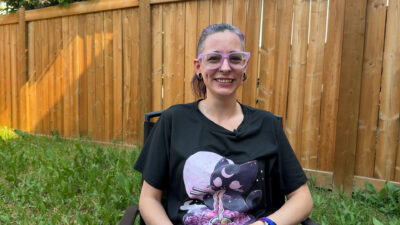
Ashley said her and her two kids are settling in nicely to their home, after receiving support through the HRIF project.
Ashley spent a year at the emergency shelter. Without the right support to find permanent housing, she thought she would never exit homelessness.
“Everything is like $2,000 for rent here, so it’s really hard to find anything … it was the kids that I was worried about, and that was the biggest part, getting a place big enough for the three of us,” said Ashley.
That’s when she met Caitlin, a Housing First coordinator with Salvation Army, hired to support the initiative. Within 32 days, Ashley had a signed lease for a three-bedroom apartment and was moving in, living with her teenage kids again after a year apart.
“It’s been a few months, and we’re doing great. The kids are thriving here. We’ve got a park next door. We’re so close to the schools that they go to … it feels like home and I hope to be able to stay here for a long time,” Ashley said.
“This has helped reset my life. I get to be a mom again.”
Housing benefit bridges affordability gap
Since moving into the house, Caitlin has worked with Ashley to connect her to longer-term income support, work on organizational skills, and connect her with parenting resources.
Everyone that Caitlin supports has a history of chronic homelessness. Many have been experiencing homelessness for four or more years.
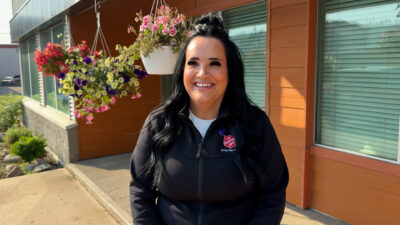
Caitlin is a Housing First coordinator with Salvation Army in Fort McMurray.
With the cost of housing, Caitlin said it is incredibly difficult to find a decent place for people to live that’s affordable for those with low incomes.
The housing benefits have been essential to bridge the affordability gap, get people into housing immediately, and then start working on longer-term income options. Those other income options, whether it’s employment, social assistance, disability benefits, or longer-term housing benefits, often take longer to arrange and that can leave people stuck experiencing homelessness while they wait.
“Being able to relieve that immediate financial pressure is such a big part of this,” said Caitlin.
Municipal funding extends HRIF project, as community continues efforts
The federal HRIF funding for the Collective Impact Initiative is set to end in November 2026.
With the clear success of the project and ongoing community efforts, previously allocated funding was approved by the Community Advisory Board (the Homelessness Initiatives Strategic Committee) to support the program’s continuation until March 31, 2027.
Nonetheless, chronic homelessness has continued to grow in the Regional Municipality of Wood Buffalo.
While outflow from homelessness has increased, meaning more people are exiting homelessness and finding permanent housing in Fort McMurray-Wood Buffalo, inflow continues to be high, with more people entering chronic homelessness than leaving it.
This project did improve the regional municipality’s homelessness response system, but that improvement alone did not result in an overall reduction.
Instead of feeling defeated, they found the funding to extend the improvement project that did work, dug back into their quality By-Name Data to see why chronic homelessness continued to increase, and are trying another improvement project to meet their reduction goals.
In April 2026, the municipality launched a second HRIF project, in partnership with CAEH, aiming to slow the inflow of people into homelessness by preventing it from happening in the first place.
The project adds a diversion position focused on identifying people at risk of homelessness earlier and working with service providers to prevent people from falling into and getting stuck in emergency shelters and homelessness.
“This is continuous improvement in action. As Fort McMurray knows from their success in ending veteran homelessness, this is how communities move from managing homelessness to ending it. They look at their data to see what’s working really well, and where are the opportunities to improve their homelessness response by stopping it from happening in the first place and helping more people find and maintain permanent homes faster,” said Richer.
“Strong leadership, a united community, and a relentless focus on ending homelessness — that’s how reductions happen.”
*This Bright Spot is funded by the Government of Canada.