
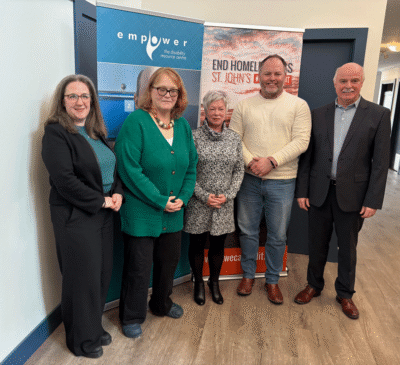
Jennifer Tipple (End Homelessness St. John’s), Kathy Hawkins (EmpowerNL), Chantal Perry (Canadian Alliance to End Homelessness), Doug Pawson (End Homelessness St. John’s), and Cape Spear Member of Parliament Tom Osborne
St. John’s, NL, March 17, 2026 – The work to reduce homelessness among people living with disabilities in Newfoundland and Labrador has taken a huge leap forward, thanks to a new project that will help shape the way communities across Canada support people experiencing homelessness to find and maintain safe, affordable and accessible housing.
In partnership with the Canadian Alliance to End Homelessness (CAEH), End Homelessness St. John’s (EHSJ) and EmpowerNL are launching Accessible Pathways to Housing. The project aims to reduce chronic homelessness in St. John’s by hiring an additional Housing Accommodation Coordinator to support more people with disabilities to find permanent homes each month.
The project is receiving $272,278 over the next year from the Homelessness Reduction Innovation Fund (HRIF) — a $45-million-dollar federal initiative led by CAEH to fund innovative projects that rapidly and measurably reduce homelessness in communities across the country.
“As homelessness surges across the country, there is so much great work happening in St. John’s to reverse the tide, to reduce and end homelessness. We are proud to partner with End Homelessness St. John’s in a project that will improve the way all of Canada understands and supports people with disabilities to exit homelessness and find a place to call home that meets their needs,” said Tim Richter, President and CEO of CAEH.
According to the 2024 Homeless Point-in-Time (PiT) Count in St. John’s, 92 per cent of people experiencing homelessness self-reported having at least one disability. Three-quarters of the 313 people experiencing homelessness during the night of the 2024 PiT Count self-reported living with two or more disabilities.
“It was staggering to see such a disproportionate representation of people with disabilities among the population of people experiencing homelessness in St. John’s. We knew we needed to act quickly to better understand the needs and improve the supports being offered, which led to the creation of this project,” said Jennifer Tipple, senior director of strategy and impact with EHSJ.
There are currently about 180 people on the By-Name Data list in St. John’s who are experiencing chronic homelessness for six months or longer with at least one disability.
The new Housing Accommodation Coordinator, based at EmpowerNL, will find additional housing units that are suitable for people with disabilities and connect them with the supports needed to keep their housing. People will be referred to receive support via the Coordinated Access table, which consists of all stakeholders in St. John’s working to prioritize people experiencing homelessness to find and maintain safe housing.
CAEH is providing one-on-one coaching and support to this project, and will publicly share the lessons learned, so the initiatives can be scaled in communities across Canada.
– 30 –
Quotes
“The barriers for people with disabilities to find suitable housing are still too high. Our government is committed to working with community partners to address that — across the full housing spectrum. This project, funded through the Homelessness Reduction Innovation Fund, will help more people find permanent homes in St. John’s that are safe, affordable and accessible. We’ll make sure it drives real results, and that what we learn shapes what we do next.”
— Hon. Joanne Thompson, MP for St. John’s East, Minister of Fisheries
“Everyone deserves a safe place to call home, and I’m proud to see this work happening right here in St. John’s. Through the Homelessness Reduction Innovation Fund, we’re supporting local partners like End Homelessness St. John’s and EmpowerNL who are doing meaningful, compassionate work to help people with disabilities move out of chronic homelessness and into stable housing.”
— Tom Osborne, MP for Cape Spear
“This program is part of a critically needed shift from managing homelessness to solving it. End Homelessness St. John’s has used their real-time data to identify a crucial opportunity to improve local support for people with disabilities who are experiencing homelessness, towards the goal of ensuring everyone in the community has a safe place to call home. Together, we will track the results, share the lessons learned, and make sure future investments are going toward solutions that we know are effective.”
— Tim Richter, President and CEO, Canadian Alliance to End Homelessness
“The data makes the challenge clear, most people experiencing homelessness in St. John’s are also living with disabilities. But behind every statistic is a person whose housing needs have gone unmet for far too long. By bringing data and lived experience together, we can design solutions that work. This project is an important step forward, and it calls on all of us, governments, service providers, and communities, to ensure accessible housing is part of the solution to ending homelessness.”
— Doug Pawson, Executive Director, End Homelessness St. John’s
“EmpowerNL is extremely pleased to expand our Housing Services Program with the availability of this funding. People with disabilities experience multiple complex barriers daily when trying to access housing and wrap-around housing supports. With the addition of this position, we know that people with disabilities will have an increased opportunity to receive the much-needed housing supports they need to find accessible housing.”
— Kathy Hawkins, Executive Director, EmpowerNL
Quick Facts
- The Homelessness Reduction Innovation Fund (HRIF) was first announced by the federal government in 2024 as part of their $1 billion commitment to Reaching Home: Canada’s Homelessness Strategy. It is a $45-million fund being led by the Canadian Alliance to End Homelessness (CAEH) over three years.
- The first round of funding was previously announced in 2025, with $7 million flowing to 16 communities across Canada to implement a range of initiatives that will prevent people from falling into homelessness and accelerate people exiting it. Communities received the one-time grants ranging in amount from $100,000 to $1.7 million.
- There will be five rounds of funding through HRIF. End Homelessness St. John’s Accessible Pathways to Housing project is part of the first round of funding to be announced. The program will run until 2028.
- To apply for funding to the HRIF, communities must have quality By Name Data that allow them to track the movement of individuals into and out of their homeless system in real time. Communities work with the CAEH and use this data to identify opportunities to reduce inflow into homelessness or accelerate housing outflow from homelessness. Once they identify opportunities for reduction, they can apply to HRIF for a one-time grant to test an intervention that will either reduce inflow or accelerate outflow to achieve a reduction in homelessness.
- The Canadian Alliance to End Homelessness is already working with more than 60 communities across Canada to create strong homelessness response systems. They have helped 48 communities to gain real-time data of homelessness in their communities, 38 communities to develop coordinated homeless systems, 13 communities to achieve measurable reductions in chronic homelessness, and four to achieve functional zero chronic or veteran homelessness.
- Reaching Home is a community-based program aimed at preventing and reducing homelessness across Canada. This program provides funding and support to urban, Indigenous, territorial, rural and remote communities to help them address their local homelessness needs.
Media Contacts
Jarrah Hodge, Canadian Alliance to End Homelessness
media@caeh.ca
Doug Pawson, End Homelessness St. John’s
dpawson@wecanendit.com