
Key Takeaways for Communities
- It’s not enough to just build more housing. To reduce homelessness, communities need to know everyone experiencing homelessness by name, and match people with the right housing option and supports they need through coordinated access.
- Some people with higher levels of need require housing and support to find and maintain housing. Thanks to stable housing and comprehensive supports provided by on-site staff and community partners, residents at the United Counties of Leeds and Grenville’s (UCLG) Movement to Improvement HRIF project have reported better physical and mental health, less involvement in the justice system, and a reduced calls to community emergency services like police and paramedics.
- Strong political leadership and support, and close coordination between all levels of government does move the needle. UCLG’s reduction in chronic homelessness happened because municipal, county, provincial and federal resources were used in coordination with non-profits to create and operate new permanent supportive housing.
- Supported by HRIF, UCLG innovated their approach to bring all levels of government together for the first time to deliver both the housing units and the supports needed to help people with the highest level of need maintain their homes.

At the far end of Brockville, Ont., there are rows upon rows of tiny homes, tucked away on a city-owned plot of grassy land overlooking the St. Lawrence River.
A former dormitory-style building converted into 24 additional one-bedroom units sits alongside the tiny homes.
These units, located on a previously vacant property, have become home to a community of 49 people previously experiencing chronic homelessness in the United Counties of Leeds and Grenville (UCLG), a mostly rural county located a couple hours’ drive west of Ottawa.
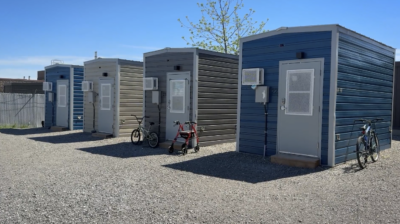
The relatively rapid development of these 49 supportive housing units has helped UCLG reduce chronic homelessness by 49 per cent from October 2025 to August 2026.
“For many years, we had no resources … homelessness was increasing … and it was very defeating. You would see the same people coming in [looking for housing and support] day after day, and we didn’t really have anything to offer them,” said Tracy Birtch, who worked for the past five years as the team leader of homelessness for UCLG.
“Seeing how something like this can come together and actually see some change, actually see some progress, actually see our numbers going down … just demonstrated that it is possible [to end homelessness],” she said.
Using provincial funding through the Homelessness Prevention Program, the Ontario Priorities Housing Initiative, and municipal funding, UCLG was able to construct the first 25 supportive cabins on land leased to the Counties by the City of Brockville. In support of the project, the City of Brockville waived the lease fee for the first year of operations.
The John Howard Society (JHS) of Kingston and District signed on to operate the supportive housing and started filling the units in February 2025 with people who’ve been experiencing homelessness for the longest time, prioritized and referred from the county’s By-Name Data (BND) and coordinated access table.
Later that fall, UCLG entered into a strategic partnership with the Canadian Alliance to End Homelessness (CAEH), receiving $836,220 in federal funding from the Homelessness Reduction Innovation Fund (HRIF) to open and staff an additional 24 one-bedroom supportive housing units in the adjacent building. HRIF supports data-driven improvement projects that aim to measurably reduce homelessness at a population level, while developing lessons that can support similar efforts across Canada.
CAEH improvement advisors worked with UCLG to design the project based on community-level data and local needs. They provided ongoing coaching to ensure the project aligns with Housing First principles and to ensure onsite case management aligns with best practices, so every resident has access to the supports they need.
The project helped usher into the county for the first time a new model of housing with intensive supports for people with the highest level of need, thanks to a blended funding model that combined municipal, county, provincial and federal resources along with sector expertise from non-profits.
“It was one of the first times locally we saw our municipal government join the United Counties in the facilitation of this project with both provincial and federal funding dollars,” said Robyn Holmes, assistant executive director for JHS of Kingston and District.
“We’ve had support from our local Member of Parliament and Members of Provincial Parliament … rooting for us and cheering us on every step of the way,” she said.
This project demonstrates what is possible when political leaders make reducing homelessness a priority, and work together to make resources and homes available, said Francisco Urrutia, CAEH’s lead improvement advisor for UCLG.
“UCLG is working hard to build a strong homelessness response system. They know everyone experiencing homelessness by name, and agencies are working collectively to match people with the housing and supports they need,” Urrutia said.
“This means they were primed to capitalize on the new supportive housing units and substantially reduce homelessness in the county by offering the right kind of housing and the right supports to those who’ve been experiencing homelessness the longest.”
When housing comes first, healing follows closely
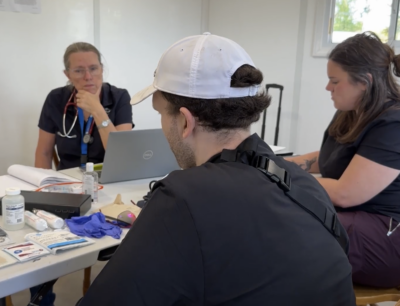
On a sunny Wednesday afternoon, a team of people swept into a modular building beside the supportive cabins, sliding chairs to desks and setting up a makeshift medical examination room.
Some were there to help residents apply for identification, get their health cards, sign up for the federal dental program or for provincial income assistance programs.
Debbie Champ, a nurse practitioner with the Summit Community Paramedic outreach team, was there to do medical check-ups — an important service for many of the residents who don’t have a primary care physician, in a city without a walk-in clinic.
“Without housing, how can you start to stabilize your food or have any healthcare? People are living under tremendous stress trying to figure out how to keep themselves safe, how to keep themselves warm … most people are just in survival mode all the time,” said Champ.
“Without housing, they don’t have any chance of healthcare … so we go to them and that’s what we’re doing here, because this is a place where many people who were formerly unhoused are living.”
While people are experiencing homelessness, healthcare mostly focuses on crisis response, making sure people have dry and warm clothes and shoes, sufficient food, and wound care. But once people have stable housing, then they can focus on normalizing their medication use and start to work on chronic health conditions and preventive healthcare, like diabetes, COPD, hypertension, vaccinations and cancer screenings, Champ said.
Housing is a key social determinant of health. Stable, affordable housing is closely linked to reduced need for emergency health services and improved mental and physical health. First responders have told the John Howard Society that the number of emergency service calls they’ve received has declined since the supportive housing complex opened.
That includes involvement with the justice system.
Jessie had been homeless for several years in Brockville — sometimes staying on a friend’s couch and sometimes trying to find a place to sleep outside.
“One thing you take for granted is having access to a shower. I hate bad smells, so it drives me nuts to not have access to showers and basic human necessities,” he said.
Jessie has been in and out of the legal system since he was a kid.
“I have trust issues. I have troubles with authority. I have literally every acronym out there: ODD, ADHD, OCD, PTSD … I have troubles with a lot of social and other things that other people would find easy,” he said.
This is just the second time since Jessie was 12 that he’s been out of jail, off probation, and not facing any criminal charges. He credits that to his intensive case manager, who’s helped him stay organized, get to court and follow his probation orders.
“It takes a lot of anxiety off me … she just understood me. She took the time … she was very patient and persistent.”
A permanent home for some, a ‘stepping stone’ for others
Everyone offered a place at the supportive housing program in UCLG had been experiencing homelessness for six months or longer.
Steve became homeless and spent almost a year living on the street after his apartment complex burned down in a fire.
Jerry never experienced homelessness until his dad passed away, but he couldn’t pay rent and ended up living outside for several years.
Kevin worked his entire life, buying his own home at 19. After a family breakdown, he moved out of the house, staying with friends or in shorter-term rentals. After a severe illness left him permanently unable to work, and an unexpected eviction from his bedbug-infested rental, Kevin became stuck in homelessness for several years.
“I went from owning a house to now, I’m homeless, all within a couple years. It was just total downhill, one after another … I thought it wasn’t going to end for a long time. Things just kept getting worse and worse,” he said.
For all three men, born and raised in Brockville, it was an unexpected series of unplanned crises that cost them their homes. With rental prices surging and a lack of deeply affordable housing, they became entrenched in homelessness.
“It took a lot of time, but here I am. Things are starting to look better,” Kevin said.
At the supportive housing program, people have a permanent place to call home. They can stay as long as they like. But there are supports available for those who want to find their own place and live more independently in private market or nonmarket housing.
That’s the goal for all three.
“This place is a stepping stone to get back into my own place … I’m looking for something nice, something small … but it’s a money thing, and I think it is for most of the people here. They can’t afford it. Either you pay your rent or you starve,” said Steve.
There has been a reduction in the number of units in the area that are deeply affordable for people experiencing homelessness and with the lowest income, said Robyn Holmes of the JHS for Kingston and District.
The local John Howard Society is trying to build more relationships with local landlords and are exploring a wide range of additional housing options, including room rentals and family networks, but affordable options are still quite limited in a small community like Brockville, Holmes said.

Aerial view of Brockville, Ontario
Meanwhile, housing subsidies can help bridge the gap between someone’s income and the price of rent, but they are few in number, difficult to access — often requiring a lease in hand — and are not long-term subsidies, which puts someone with a fixed income at risk of falling back into homelessness if the subsidy ends.
“Ultimately, we want to see everyone in safe housing that is appropriate and accessible for them and their physical, mental and emotional needs. That’s what they deserve,” said Holmes.
The United Counties has a 10-year plan to reduce homelessness, including a goal to create 150 supportive housing units by 2035. This supportive housing complex has helped UCLG reach one-third of that goal.
But to reduce, end and ultimately prevent homelessness, the county needs more deeply affordable, nonmarket and supportive housing, with the resources to offer the supports people need to maintain their homes for the long-term.
*This Bright Spot is funded by the Government of Canada.