
Key Takeaways for Communities
-
Non-market and private market landlords have a crucial role to play in ending homelessness—preventing it before it happens by working with tenants to understand issues that are challenging the tenancy, and offering supports where possible.
- There are many agencies and resources in every community that are working toward the same goal: keeping people housed. No one agency or landlord can offer the full range of supports that people need. Find those agencies in your community—often they’ll be at the coordinated access table.
-
The National Conference to End Homelessness gave Dana White the knowledge, the tools and the contacts to help Civida, the largest community housing provider in Edmonton, prevent evictions and foster more successful tenancies.
Doors for coming and going. A wall of steel mailboxes. Elevators pinging.
Looking at it, you might think this is a typical lobby. It’s anything but.
For staff and residents at O’Day-min Village, the lobby is a gathering place.
On this day, Aunty Donna has come by for the weekly “Cooking with Aunty” session. People take turns learning to make bannock, and cook dozens of burgers for a community barbecue, thanks to a partnership with the community agency Amity House.
Residents decorate small leaves to hang on a lobby tree.
A nearby grocery store drops off boxes of donations — fresh bread and fruit — for residents to take, as needed.
“It’s the Grand Central station of it all … it’s for those high fives with staff when somebody got a job interview. It’s for the conversations when someone is struggling with something,” said Dana White, a district manager with Civida, the largest community housing provider in Edmonton.
The complex is filled with a diverse cross-section of people, from families to seniors, newcomers to Canada to people with long histories experiencing homelessness, and relationships across age, cultural, ethnic and linguistic diversities, all living under one roof.
When Civida acquired the 149-unit apartment complex in 2023, it became the largest singular expansion of community housing in Edmonton in years. One hundred units are deeply affordable, with residents paying a set price of 30 per cent of their income, and the remaining units are near-market rentals, costing 20 per cent below market rent.
But Civida didn’t just want to expand their housing stock. They wanted to try something different to reduce evictions and build community — something they’ve worked hard to accomplish in the last three years.
“It’s certainly not just managing housing, and it’s not just managing tenants. It is making sure every tenant here feels that they’re part of a community and that they’re loved. And we’ve seen such a difference when somebody knows they’re cared for and safe,” said White.
When White started with Civida as a compliance clerk, her job included working with tenants whose housing was already at risk of being ended due to financial, behavioural or lease-related issues.
But, listening to tenants she heard stories of past trauma. People who didn’t feel heard or valued. Family breakdowns. Physical and mental health struggles. Job loss.
“I ask them, ‘where would you be if you weren’t here?’ And generally, it’s couch surfing, or at a shelter, or out on the street begging for a home,” White said.
“The stakes are so high. When you’re in community housing, you’re already so vulnerable. You’re struggling financially. There’s no place to go.”
More than 3,700 people in Edmonton are experiencing homelessness, according to the publicly available By-Name Data (BND). The vast majority have been homeless for more than six months.
Shifting from compliance to eviction prevention
In 2023, White attended the National Conference on Ending Homelessness in Halifax.
“I cried every day I was there in the best ways. I made notes in every breakout room. I was extremely inspired. It was so simple: Nobody wants to lose their home. And if you don’t want to lose your home, and I can help you … let’s connect, let’s come up with a plan together,” she said.
White said she learned more about the realities and common barriers to housing facing people experiencing homelessness. She was equipped with the tools and resources she needed to help prevent evictions, learning from experts across the country.
She learned she wasn’t alone in wanting to do this work.
“Those agencies are out there, and I suppose I didn’t know we could go get them. I didn’t know we could say, ‘Hey, I have a tenant who is about to be evicted, here’s their story that I’m sharing with permission. What is it that your organization can do?’”
White left the conference armed with contacts, empowered to build bridges with other agencies that shared the same goal of keeping people housed.

Dana White is a district manager with Civida, the largest community housing provider in Edmonton.
It was the exact knowledge she needed to support Civida’s ongoing transformation toward being more than just a landlord and focusing on sustainable tenancies.
Now, instead of just moving to evict people, White and her team have conversations, and offer connection, care and support. Building trust as a foundation to honest, two-way communication is the magic key, she said.
“Now that I know what you’re struggling with, let’s see who can help. Maybe it’s Civida, but it’s generally our community partners. I come back to my office and start sending out emails, with consent, saying ‘hey, we have this tenant, this is what they’re struggling with — food insecurity, arrears, domestic violence, addiction,” said White.
“And 99 per cent of the time, people are coming to the table. The tenant has agreed to the help, and that tenancy is now on the way to being successful, sustainable and healthy.”
As the District B Housing Clerk, Doreen says her job is mostly “chasing people for accounts and paperwork,” ensuring tenants are submitting the necessary documents and paying their rent.
Many residents come in with existing, often multi-generational trauma of housing instability and a challenging relationship with prior landlords, potentially including a history of being evicted.
Some new tenants expect the same treatment from Civida, Doreen said. Instead, she prioritizes building relationships with tenants founded on trust. When issues come up, she helps problem solve, which can look like connecting them to community-based resources or having open and frank conversations.
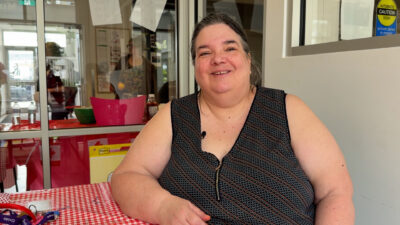
Doreen is the District B Housing Clerk with Civida.
“When I’m honest with them and I’m helpful, they start to trust me, and they’ll start coming before the problem escalates to the point where their tendency is shaky,” said Doreen.
She is regularly in contact with other agencies in the community that offer support to tenants.
Some time ago, she connected with Bent Arrow, an Indigenous traditional healing society with housing programs in Edmonton. Together, they helped many tenants overcome significant rent arrears, creating stability for families who were at risk of losing their housing.
‘People need people’
Sharon, 67, is one of the first people that White met when she started working for Civida.
She moved into the building in 2020. Sharon is short and spirited, standing at just 4’9”.
“I used to be 5’1, you know.”
For years, she drove transport trucks and heavy machinery across Western Canada. Her career and source of income ended abruptly when she broke her back.
For 10 years, Sharon lived on and off in her car, until she was offered a place in her current home in 2020, before it was taken over by Civida.
“I didn’t know anybody. Everybody was cheery. I went to bed that night and I thought, no rain to get me? That’s new … this is an awesome place. They made me feel welcome,” she said.
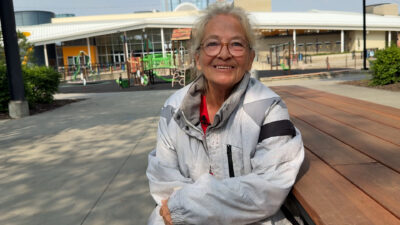
Sharon moved into O’day-min Village in 2020.
To say Sharon doesn’t get along with everyone would be an understatement. She’s quick to call out residents for behaviours she doesn’t like and is apt to take things into her own hands if she doesn’t think those behaviours are being dealt with appropriately.
“I’m just me, right. I’m in your face. Bold. And if you can’t do it right, get out of here. And Civida seems to get me, because I’m still here. They haven’t kicked me out yet, and I’m pretty sure they have grounds,” she said.
But Sharon likes most of the tenants at O’Day-min Village.
“People need people. We need somebody that, if I want to sit and talk to, I can. Just anybody that walks past me, if I’m not having a good day, they’ll ask me what’s wrong … they tell me it’s going to be better,” she said.
Carmen feels that same sense of community. She spends most of her days in the resource room and the community garden, right by the lobby at O’Day-min. She usually gets the coffee going in the mornings, and welcomes new residents when they move in.
It’s a big change since she moved in four years ago.

Carmen spends most of her days in the resource room and the community garden, right by the lobby at O’Day-min.
“I was an angry person. I was mad at the world. I didn’t talk to anybody, I just kept to myself.”
She was wracked with grief, having just lost her husband and her house in a fire. Unable to stay in her home First Nation, Carmen moved to Edmonton and was accepted into O’Day-min after months splitting time between her daughter’s place and a hotel.
“The staff here care about you. They helped me grow, I just see so much of a difference in the four years that I’ve been here. And now it’s just like my big happy family here. I don’t have to feel alone,” Carmen said.
Building community must be intentional
David Berger worked to build community at O’Day-min Village from 2023 to 2025 as the Community Connector, in a pilot project funded by the city.
When he started, Berger said there was already a sense of community in the building, thanks in large part to one longtime resident named Tim.
He would make birthday cakes for residents on their birthdays, and hosted a monthly barbecue for the entire building, food cooked and paid for exclusively by Tim alone. He took a lead role in caring for the community garden.
Tim died in the spring of 2026, but his legacy of bringing residents together for shared meals continues to this day.
Part of Berger’s work involved creating additional social opportunities like bingo nights and movie nights. But he also focused on identifying residents’ needs and bringing in community agencies who could help people build greater financial and food security and improve their physical and mental health.
“Our driving motive was to bring both the enjoyment side of things, but also on the service side to help people feel connected to the supports that they needed,” Berger said.
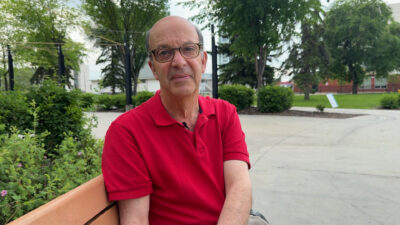
David Berger worked to build community at O’Day-min Village from 2023 to 2025 as the Community Connector.
Many people living in social or community housing are struggling with personal and multi-generational trauma, but they don’t have needs acute enough to require permanent supportive housing, which often has 24/7 onsite support services.
The challenge for social housing providers is to take that next step beyond just housing, to look at the fundamental causes why people feel disengaged or marginalized by the broader community and think about what it means to help residents heal at their own pace, Berger said.
“Social housing providers know that a roof over one’s head is not enough. But the gap is really the ability to find the money that would help bring resources and build that sense of community.”
When those housing providers find a way to build community and offer those supports, it has the potential to change lives and create housing security.
*This Bright Spot is funded by the Government of Canada.