
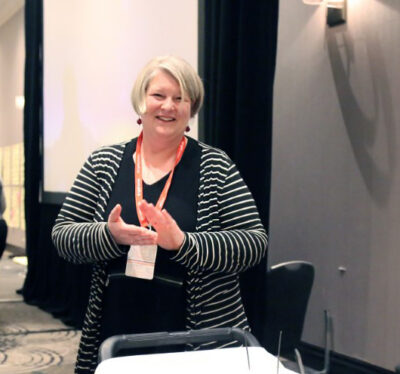
 When Marie Morrison first started her career in the homelessness sector, no one had heard of By-Name Data or Coordinated Access — two fundamental elements now considered essential in the work to end homelessness.
Housing First wasn’t a term yet coined.
To say the sector’s approach has shifted since then would be a remarkable understatement.
“We can fairly say Marie has helped revolutionize Canada’s response to homelessness. We’ve grown a movement from what she developed with Built For Zero-Canada, and she has set in motion a legacy that is going to continue far beyond her time,” said Tim Richter, President and CEO of the Canadian Alliance to End Homelessness (CAEH).
“She’s just been this force of nature for so long. She threw her heart and soul into this work, and you can see it,” Tim said.
Career started in Waterloo
Marie’s career in the sector began in 2001. At the time, as the system manager for homelessness with the Region of Waterloo, she was responsible for coordinating federal, provincial and local funding to respond to homelessness.
She built local relationships, mapped existing services, gathered data and wrote plans — gradually shifting from a mindset of managing homelessness to ending it.
“We were overwhelmed and pulled in so many directions. There was not a clear path on how we could support the community to get there. We were very “connected,” and thought we were collaborating and coordinating our efforts, but really, we were still offering services to people in silos,” Marie said.
That changed in late 2014, when Waterloo became the first community in Canada to implement a Connection and Action Week as one of a few pilot communities for the then-fledgling CAEH’s 20,000 Homes Campaign.

Marie Morrison gives a speech about the 20,000 Homes Campaign.
Better than a static Point-in-Time Count, which collected data that was immediately outdated and didn’t allow for follow-up, the Region of Waterloo gathered actionable data asking for the consent of people experiencing homelessness to collect their names and information on housing and health needs.
“This was the beginning of our By-Name Data, a comprehensive, real-time list of everyone experiencing homelessness in the community, from which we could work together to offer people support. It allowed us to have a shared, ongoing count of the number of people experiencing homelessness and how people were flowing into and out of the system. We never had this before. We really didn’t know how many people were experiencing homelessness and what their needs were,” said Marie.
This was the foundation of the Built for Zero approach. It focused on making system improvements to generate an immediate impact. It allowed the community to work collectively to house people from a shared list, tracking progress each month and in real time.
“It gave us a pathway to focus our efforts, along with tools, individualized support, and continued opportunities for peer exchange in the work toward zero,” she said.
In 2017, Marie left the Region of Waterloo to become just the fifth staff member of CAEH — which now has more than 40 staff members — to lead the 20,000 Homes Campaign and ultimately, Built For Zero-Canada.
Building a movement
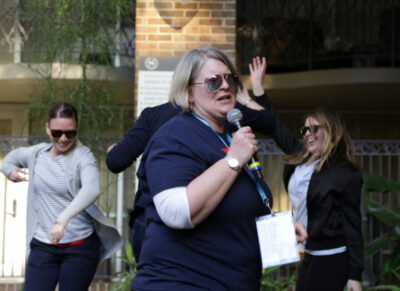
Today, Built For Zero-Canada has supported more than 80 communities across the country in their work to end homelessness.
More than 50 communities have high quality, real-time data. Many are reducing homelessness, and some had even reached functional zero for a population — when local community systems are able to rapidly rehouse people when they fall into homelessness.
Since the 20,000 Homes Campaign launched, the communities supported through Built For Zero-Canada have housed people more than 100,000 times.
None of that was true when Marie started with CAEH.
“If you think about the impact one person has had … Marie has easily touched the lives of all those 100,000 people in one way or another,” said Tim.
“She carried the whole thing on her back by herself for a while and then built the team that became Built For Zero-Canada. None of this would’ve happened without her,” he said.
The movement now has access to resources, from checklists and scorecards to a methodology of continuous improvement and failing forward: things that Marie piloted and introduced.
“Her approach is kind, solid, head down, do the work. And she is deeply, deeply committed to it,” Tim said.
Impact felt around the world
Amanda DiFalco, now the senior director of strategy and people with CAEH, has worked closely with Marie for more than a decade, starting in the homelessness sector with the City of Hamilton.
At the time, Hamilton was also one of the first communities in Canada to conduct a Point-in-Time Count, and later joined Marie and the Region of Waterloo as one of the pilot communities with CAEH’s Connection and Action Week and the 20,000 Homes Campaign.
As part of their groundbreaking work in the shift from managing to ending homelessness, Amanda and Marie were both selected to represent Canada at an Institute of Global Homelessness leadership program in India.
“We found ourselves in a room with homelessness leaders from across the globe, in a country and culture that was new to both of us. What struck me wasn’t any single moment — it was watching Marie move through that entire experience,” Amanda said.
“Whether she was learning from a local leader, navigating a cross-cultural conversation, or simply exploring what was around us, she brought the same qualities to every interaction: genuine curiosity, no pretence, and a real desire to understand before she spoke. She didn’t arrive with answers. She arrived with questions. And because of that, people opened up to her,” she said.
When David Pearson first met Marie, he says there were just four Built for Zero/Advance to Zero communities in Australia.
“Honestly, I didn’t really know what I was doing. I was just so impressed with what had been achieved by Built for Zero-Canada,” said David, the CEO of the Australian Alliance to End Homelessness (AAEH).
“Now we have more than 30 communities and we are clear-eyed about our strategy, based on learning and our practice rooted in improvement. All of this is in no small part thanks to Marie. She has been an unwavering colleague, collaborator, mentor and friend – always willing to share a resource, a checklist, an insight or a supportive ear. She will be deeply missed from the international community of practice,” he said.
Melanie Lewis Dickerson, the chief programs officer with Field Impact in the United States, worked with Marie on the 20,000 Homes Campaign, and later to create Built for Zero-Canada.
“I’m grateful for her friendship, leadership, and support. She should be very proud of the lasting impact she has made in Canada and around the world,” Melanie added.
At the end of her career, Marie shares a note of gratitude
Looking back at her career, Marie says it has been an honour to work with so many mentors, friends, and leaders who have inspired and supported this work.
Marie says she wants to thank the people at the heart of this movement.
“Community leaders in Built for Zero are remarkable — not because the work is easy, but because they choose to lead where the work is hardest. They take systems that most people find overwhelming, and turn them into coordinated action. They bring humanity into every room they enter, building trust across agencies, across sectors, and across lived experience. They insist on clarity, on real-time data, on seeing every person by name — because they know that precision is what makes progress possible,” said Marie.
“They don’t wait for perfect conditions. They test, they learn, they adapt, and they try again. They build relationships that change what’s possible. They hold a bold vision and make it feel achievable. And perhaps most importantly, they create cultures where hope isn’t just a feeling, it’s a practice. These leaders are proving, community by community, that ending homelessness is not only necessary, but absolutely within reach.”
Marie says over the years, she has often thought of a quote by Jim Rohn: ‘Don’t wish it were easier. Wish you were better.’
“I hope we have helped in a small way to make this work a bit easier, less lonely, and made us all better in working to achieve our mission to end homelessness,” said Marie.
Marie retires from CAEH on March 31, 2026.