

Winnipeg, MB, Nov. 4, 2026 – The Canadian Alliance to End Homelessness (CAEH) presented its inaugural National Homelessness Reduction Award to six individuals and organizations at the 2026 National Conference on Ending Homeless in Winnipeg on November 4. The awards celebrate the people, organizations and communities whose leadership is helping end homelessness across Canada.
“We know that ending homelessness is possible,” said Tim Richter, CAEH President and CEO. “Through the National Homelessness Reduction Awards, we’re proud to shine a light on the people who are doing the incredibly hard, and often invisible work to ensure that everyone has a place to call home.”

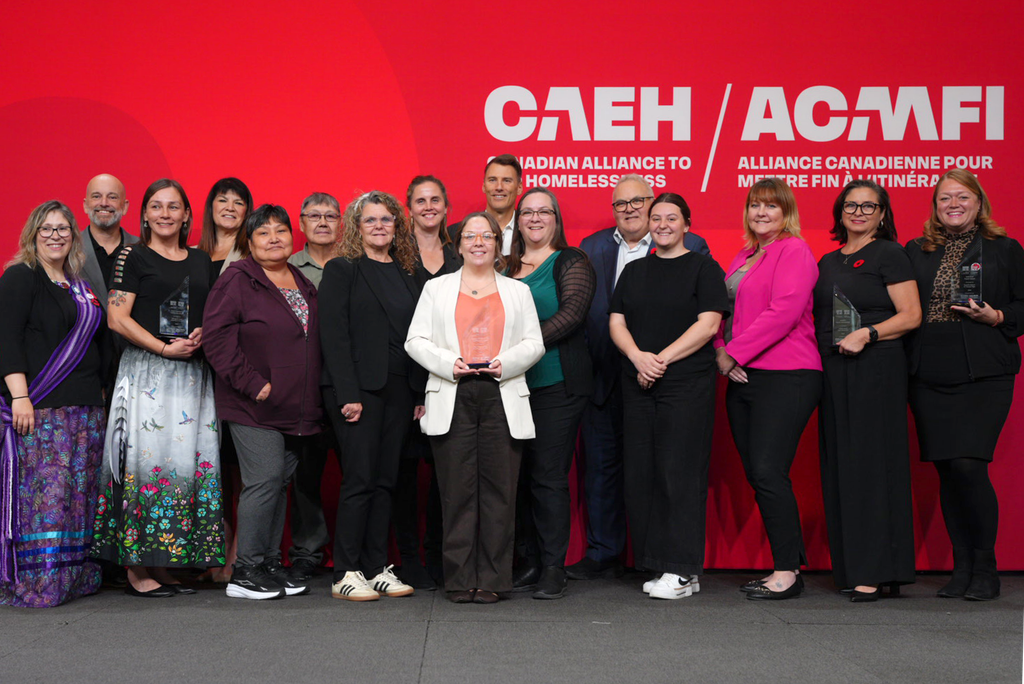
The awards offer examples, ideas, and inspiration for ending homelessness. The 2026 recipients were recognized across six categories, in addition to the Paula Goering Memorial Scholarship which was awarded to two recipients:
Lived Experience Leadership Award: Thompson Lived Experience Circle. Through the “Thompson Model,” Thompson has become the first community in Canada where people with lived experience are primary decisionmakers around funding and project development. The Thompson Lived Experience Circle, whose members are predominantly Indigenous and have all experienced homelessness in the community, has the final say on which initiatives move forward and how resources are used. Its decisions are final, ensuring that those most impacted by homelessness can shape the systems meant to help them.
Indigenous Homelessness Impact Award: N’Dinawemak – Our Relatives Place. N’Dinawemak is a Winnipeg-based organization grounded in Indigenous Ways of Knowing and has grown from a single shelter to four sites that include shelter, transitional and permanent housing, outreach and safety. The organization calls itself a learning facility where those who use the services, known as Relatives, become volunteers and then staff. The N’Dinawemak workforce is nearly all Indigenous, and 70% have lived experience of homelessness.
Municipal Leadership Award: Joe Preston, Mayor, City of St. Thomas, ON. Mayor Joe Preston made housing, homelessness and community well-being a key priority for the City of St. Thomas. His leadership helped moved the community from managing homelessness toward creating a coordinated system offering prevention, supportive and affordable housing, and services that create pathways to housing independence. The City has eliminated veteran homelessness and reduced all homelessness by nearly 50% over the last three years.
Individual Impact Award: Danielle Neilson, Acting Director of Social Services, City of St. Thomas, ON. Though her leadership with St. Thomas-Elgin Social Services, Danielle has helped build a coordinated, compassionate response to solving homelessness. She united municipal departments, housing organizations, healthcare providers and community agencies around the shared goal of ensuring homelessness is rare, brief and non-recurring. Danielle’s leadership has produced measurable results. The community has housed hundreds of people, built new affordable and supportive homes, improved access to healthcare, and achieved functional zero veteran homelessness.
Community Innovation & Reduction Award: United Counties of Leeds and Grenville (UCLG). Since October 2025, UCLG has reduced chronic homelessness by 52 per cent through the Movement to Improvement Project, a Homelessness Reduction Innovation Fund project. Bringing together municipal, provincial and federal resources, along with non-profit expertise, the community recently opened 49 supportive housing units in Brockville that are operated by the John Howard Society of Kingston and District and serve people experiencing homelessness for six months or more. The Counties’ work is demonstrating that ending homelessness is possible.
Lifetime Achievement Award: Susan McGee, Chief Executive Officer, Homeward Trust Edmonton. Susan has helped transform how communities respond to homelessness in Edmonton and across Canada. She led Edmonton’s 10-Year Plan to End Homelessness and championed approaches that now define the sector, including coordinated access, shared data, performance measurement, integrated funding and collaborative oversight. Susan launched Edmonton’s Housing First programs in 2009, which have since housed almost 23,000 people. She embedded Indigenous priorities into housing programs, strengthened collaboration between government and non-profits, and helped shape national homelessness policy. A generous mentor, McGee has left a legacy of lasting change, stronger leaders and thousands of people with a place to call home.
Paula Goering Memorial Scholarship. Dr. Paula Goering, RN, PhD was a distinguished clinician and educator who made a tremendous contribution to research, services and policies targeting homelessness in Canada. The Paula Goering Memorial Scholarship recognizes Paula’s role as a mentor to students, a practitioner, and a pioneering researcher who focused on translating knowledge into practice. The Scholarship is awarded each year to two students or Housing First practitioners who share Paula’s passion for ending homelessness and her commitment to evidence-based practice. The 2026 Scholarship winners include:
Hannah Lavinge, Coordinator, Supportive Housing Burdock. Hannah is a healthcare and social services professional who leads a harm reduction-focused program supporting people experiencing homelessness, mental health challenges, substance use and complex health needs. She believes in meeting people where they are while working toward practical solutions that foster dignity, connection and healthier communities.
Victoria Rozycki, PhD Student, Community Psychology, Community Mental Health Research Lab, Wilfred Laurier University. Victoria’s research focuses on housing justice and harm reduction. She has been involved in many community-based research programs and is the research and project coordinator for an initiative aimed at advancing research on Housing First adaptations and evidence-informed implementation across Canada.
For more information, contact demers@redbrick.ca