

Five Canadian communities achieve measurable reductions in homelessness
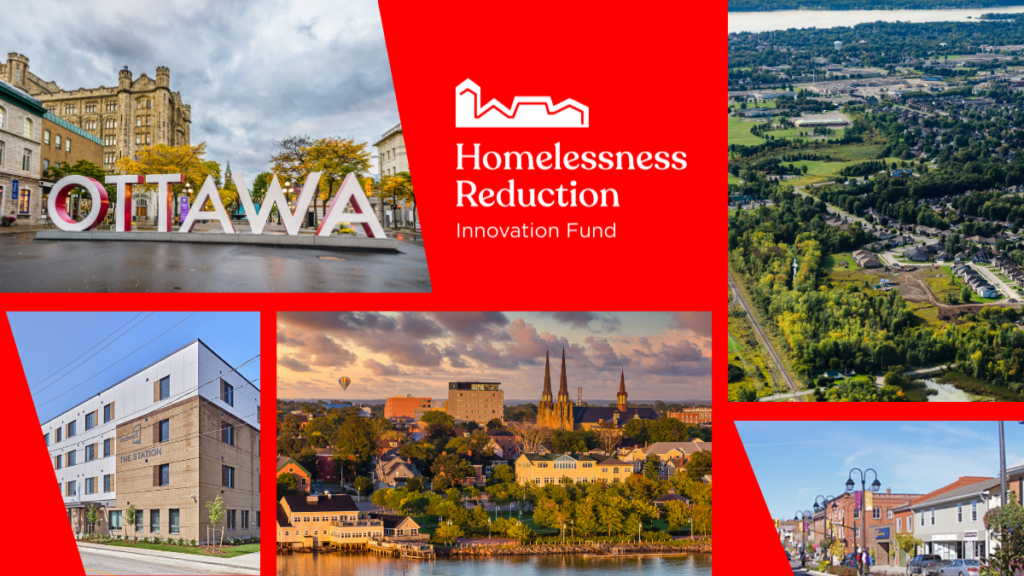
OTTAWA – October 29, 2026 – In the face of an unprecedented surge in homelessness across Canada, five communities have achieved measurable reductions in homelessness over the past year.
These reductions were achieved through their partnership with the Canadian Alliance to End Homelessness (CAEH), with funding and support from the Homelessness Reduction Innovation Fund (HRIF).
The $45-million fund led by CAEH and funded by the federal government through Reaching Home, supports local, data-driven improvement projects that aim to measurably reduce homelessness in a community. The first wave of funded projects was announced one year ago, at the 2025 National Conference on Ending Homelessness.
The communities that have achieved these reductions include (more details below):
- United Counties of Leeds and Grenville, ON: 52% reduction in chronic homelessness since October 2025
- St. Thomas-Elgin, ON: 37% reduction in chronic homelessness since October 2025; and a 50% reduction in youth homelessness since February 2026
- Ottawa, ON: 21% reduction in youth homelessness since January 2026
- Prince Edward Island: 15% reduction in total homelessness since January 2026
- Halton Region, ON: 9% reduction in total homelessness since August 2025
More than a dozen other communities have made measurable improvements to the way they respond to homelessness —for example, measurably reducing inflow into homelessness or helping more people move faster from homelessness to homes — thanks to their partnership with CAEH through HRIF.
Through HRIF, CAEH has been road-testing a new Model for Ending Homelessness. CAEH developed the model after more than a decade of working with communities across the country, drawing on best practices from around the globe, and learning what works and what doesn’t to meaningfully reduce homelessness.
“These early results show that not only is homelessness solvable, but there is a proven, adaptable approach any community can use to get there,” said Tim Richter,CAEH’s founder and president.
According to federal government data, homelessness has nearly doubled nationwide over the past eight years. A recent poll by Abacus Data and CAEH found that more than one-third of Canadians know someone impacted by homelessness and nearly one in 10 say they have direct experience with homelessness. An overwhelming majority said they support investments in proven solutions.
Currently, many communities’ efforts are fragmented and focused on responding to the crisis of surging homelessness. CAEH’s model shifts the focus from managing homelessness to ending it, ensuring every person experiencing homelessness is known and every community partner is working collectively to prevent homelessness whenever possible to create the shortest path from homelessness to housing. The community then uses data driven continuous improvement to improve their response until every neighbour has a safe place to call home.
Now CAEH is expanding support so more communities can implement this proven model, launching a range of support to meet different communities where they’re at. This includes free tools and resources, training, and peer learning to support and resolve specific challenges in community. A refreshed Built for Zero Canada partnership, along with fractional services to boost capacity, will work to support the heavy lifting as communities work to end homelessness. Services are tailored to local needs and offered through a non-profit fee structure focused on affordability and value.
To coincide with the service launch, CAEH also unveiled a new website and visual identity just ahead of the 13th annual National Conference on Ending Homelessness, taking place in Winnipeg from November 3 to 5.
“In partnership with communities across the country, we’re changing how Canada responds to homelessness. To support that change, we have re-imagined how we work as well,” Richter said. “Our new look embodies our bold leadership and mission to reverse the lethal trajectory of homelessness in Canada.”
-30-
For more information, visit www.caeh.ca.
Media contact: Jacqueline Demers, 416-859-6250, demers@redbrick.ca
Additional Information:
The following list includes details about the six Homelessness Reduction Innovation Fund (HRIF) projects that have helped drive reductions in homelessness in five communities across Canada.
- United Counties of Leeds and Grenville (UCLG), ON — In October 2025, the county government launched their HRIF project Movement to Improvement: Building a Housing Continuum Model, aiming to reduce chronic homelessness by repurposing 24 transitional housing units into permanent supportive housing. The project has helped UCLG achieve a 52% reduction in chronic homelessness.
- St. Thomas-Elgin, ON (chronic homelessness) — In October 2025, the regional municipality launched Prevention in Action: A New Team, A New Commitment to Ending Homelessness aiming to reduce homelessness by creating a dedicated homelessness prevention team focusing on early intervention and housing stabilization. The project helped St. Thomas-Elgin achieve a 36.5% reduction in chronic homelessness.
- St. Thomas-Elgin, ON (youth homelessness) — In February 2026, the regional municipality launched Zero in Sight: Ending Youth Homelessness aiming to reduce youth homelessness by creating two full-time, housing-focused case managers dedicated to supporting youth experiencing homelessness. Just eight months into the 12-month project, the community has already achieved a 50% reduction in youth homelessness.
- Ottawa, ON — In January 2026, Ottawa launched their HRIF project Ending Youth Homelessness in Ottawa through Scattered Community Integrated Head-Leasing, which aims to reduce youth homelessness by creating an innovative head leasing model securing housing for youth and offering them support before and after they move in. Just nine months into the 12-month project, the community has already reduced youth homelessness by 21%.
- Prince Edward Island — In January 2026, the John Howard Society of PEI launched the Prevention & Diversion Program aiming to reduce total homelessness by working with people and families that previously experienced homelessness and are at risk of losing their housing to provide emergency interventions to help them maintain their housing. Just nine months into the 12-month project, the province has already achieved a 19% reduction in all homelessness.
- Halton Region, ON — In August 2025, the regional municipality launched the Halton Housing Stability Project aiming to reduce all homelessness by identifying early warning signs for people and families at risk of losing their housing, and intervening before an eviction occurs. The regional municipality has achieved a 9% reduction in all homelessness, 14 months into their 18-month project.